Subsurface Leak Forensics
Underground Water Leak Detection London
An external supply run is the one part of a property where the elimination stage is worth disproportionately more than the detection stage, because the cost of being wrong is measured in excavation rather than in plasterboard. A buried run is long, invisible, frequently undocumented and often shared, and every one of those facts is cheap to test and expensive to assume.
Quick answer
Before anything is surveyed outside, the loss has to be proved to be outside. Internal outlets are closed and the meter is watched, then the internal stop tap is closed and the meter is watched again. Ownership is settled next, because the communication pipe up to the boundary belongs to the water undertaker and a shared supply may make the excavation somebody else's decision too.
What builds the fee on an external supply survey
| Stage of the survey | What sets the fee | What lengthens it |
|---|---|---|
| Timed meter tests to split internal from external | Whether the meter is accessible and the internal stop tap operable | Seized stop taps and meters in chambers under hard standing |
| Tracing and recording the route | Length of run and whether its position is documented at all | Plastic mains with no trace wire, which will not locate conventionally |
| Establishing the boundary and any shared supply | Number of properties on the run and where the demise sits | Terraced streets where several owners share one pipe |
| Bracketing by section, then placing the loss | Whether sectional valves exist and what the pipe is made of | Plastic pipe, which rules out acoustic work and forces gas |
| Marking one excavation and noting other services | Surface type and the depth the run sits at | Congested service corridors near the boundary |
We do not publish a price list, because the figure is built from the property rather than picked from a menu. The detection fee is confirmed in writing before an engineer travels, and repair is quoted separately once there is a located point to quote against.
The test sequence is unglamorous and decides most jobs. Every internal outlet is closed and the meter is watched over a timed interval. Then the internal stop tap is closed and the meter is watched again. Movement with the internal tap shut puts the loss on the external side of that valve, and stillness puts it inside the building, and knowing which of those is true before anyone books a survey of a garden is worth more than any instrument.
Ownership is the second thing to settle and the one most often skipped. The communication pipe up to the property boundary belongs to the water undertaker, while the supply pipe from the boundary to the building is normally the property owner's, and suppliers including Thames Water will frequently repair or contribute towards a first leak on an external supply pipe. In terraced streets a single shared supply serving several houses is common, which makes both the liability and the excavation a matter for more than one owner. All of this is a set of phone calls and a look at the deeds, not a survey.
The fee is built from the length of run to be covered, whether its route is documented or has to be traced from scratch, what the surface is made of, and whether the pipe material forces a second method because acoustic work will not carry. It is agreed in writing before an engineer travels and covers detection and the written record. Excavation, repair and reinstatement are quoted separately by whoever carries them out, and where the finding sits on the water undertaker's side of the boundary the appropriate next step is a claim to them rather than a bill from us.
What you get
- Acoustic correlation for precise location of leaks under timber floors or in deep drainage runs, filtering out ambient building noise.
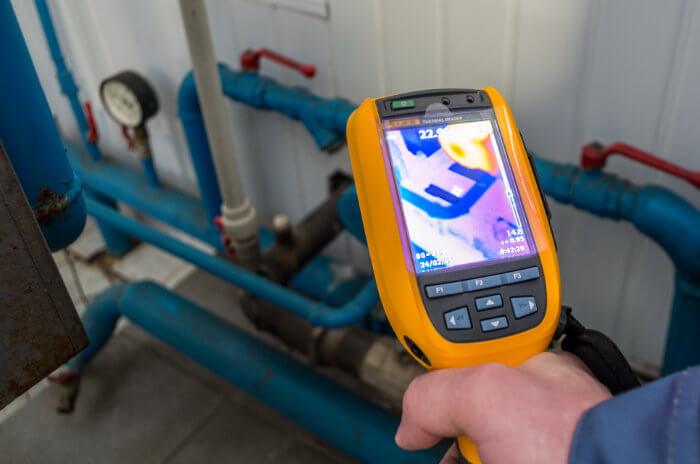
- High-resolution thermal imaging to identify thermal anomalies in concrete slabs and behind finishes, indicating cooler water paths.
- Tracer gas (hydrogen/nitrogen mix) injection for non-destructive testing of pressurised systems and complex, multi-layer substrates.
- Non-invasive moisture mapping using capacitive and resistance sensors to delineate the extent of water migration from the source.
- Diagnostic reports include annotated thermograms, acoustic signatures, and moisture maps for contractor instruction or insurance evidence.
- Method selection is guided by an initial site assessment of pipe access points, construction type, and pressure test results.
How it works
A method, not a guess
01
Prove the loss is outside before surveying outside
Timed meter observations with all internal outlets closed, then repeated with the internal stop tap closed. The two readings together separate an internal fault from an external one and give a rate of loss that sets the scale of what we are looking for. A survey commissioned without this step is a survey that may be pointed at the wrong side of a wall.
02
Establish the route and who owns which part of it
The run is traced and recorded with a pipe locator where the material allows, and the boundary position, meter location and any shared arrangement with neighbouring properties are established from what is on site and in the deeds. Where the loss sits on the undertaker's side of the boundary, the correct next step is a call to them rather than an excavation by us, and we say so.
03
Bracket the loss, then place it
Where sectional valves exist the run is split and each section watched separately. Metal sections are correlated acoustically. Modern plastic mains, which mute the acoustic signal almost entirely, are taken with tracer gas introduced into the drained section and picked up at the surface, with a peak required to reproduce after ventilation before it is treated as a location.
04
Define one excavation, and record what you did not dig
The point is marked on the surface and dimensioned from two permanent features, the estimated depth and the surface build up are stated, and other buried services in the vicinity are noted so a contractor does not find them the hard way. The sections tested and cleared are recorded too, because a second contractor should not repeat work already done.
Before you book anyone
Six things to establish before you pay to survey a buried pipe
01
Do the meter test before you commission anything
It costs nothing and it decides the job. Close every internal outlet, note the meter reading and leave it for a timed interval, then read it again. Then close the internal stop tap and repeat. Movement with the internal tap shut puts the loss on the external side of that valve. Stillness puts it inside the building, which means a garden survey would have been pointed at the wrong side of a wall. This single sequence is the difference between commissioning the right investigation and commissioning an expensive one in the wrong place.
02
Settle who owns the pipe before anyone quotes for digging
The communication pipe running up to the property boundary belongs to the water undertaker. The supply pipe from the boundary to the building is normally the property owner's, although suppliers including Thames Water will often repair or contribute towards a first leak on an external supply pipe under their published policy. These are phone calls and a look at the deeds, not a survey, and they occasionally remove the need for one altogether. Commissioning detection on a pipe you do not own is a straightforward way to spend a fee you did not need to spend.
03
Find out whether the supply is shared before you dig anybody's garden
Single runs serving several terraced properties are common across older London stock and are frequently only discovered part way through an excavation. A shared supply changes almost everything: the loss may not originate on your land, the metered consumption may not be only yours, the liability is divided, and the excavation may need agreement from neighbours whose surfaces will be disturbed. Isolating properties one at a time where valves permit and watching the meter apportions the loss before anyone commits to a dig.
04
Ask what happens if the pipe turns out to be plastic
Blue plastic mains absorb the frequencies acoustic equipment depends on, so a sweep along the route can pass over a substantial leak and register nothing. That is not a failure of the engineer, it is a property of the material, but it becomes a failure if nobody mentions it before the booking. On plastic the workable approach is bracketing the run by sectional isolation where valves allow, then introducing tracer gas into the drained section and detecting where it surfaces. It is slower than acoustic work on metal and gets scoped and priced accordingly.
05
Refuse a dig first quotation
Excavation is the expensive part of an external leak by a wide margin, and a trench along a suspected route is not a diagnosis, it is a search conducted with a machine. The purpose of the survey is to convert a route into a point so that one hole is opened rather than a line. Where a firm's answer to a difficult trace is more digging, the cost of their uncertainty is being transferred to you in the most expensive currency available.
06
Ask for the tolerance and the depth, not an accuracy claim
Precision on a buried run falls away with depth, with surface build up and on plastic pipe, so any firm quoting one accuracy figure for every job is quoting a brochure rather than a measurement. What a groundworker actually needs in order to price is a marked point dimensioned from two permanent features, a stated tolerance with the reason for it, an estimated depth, a description of the surface build up, and a note of the other buried services in the vicinity. That is the difference between pricing a dig and discovering one.
Compare like for like
Prove it is outside, then prove whose pipe it is
On an external supply run the cost of being wrong is measured in excavation, which makes the two cheapest steps the most valuable ones: establishing that the loss is actually outside, and establishing who owns the pipe. Here is how those steps are treated three ways.
| What to check | A visit that starts by scanning | A firm that finds and opens on one price | London Leak Detection 247 |
|---|---|---|---|
| Proving the loss is external | Assumed from a high bill or a supplier letter, and the survey starts in the garden. | Assumed, because an external job is a larger job. | Timed meter observations with all internal outlets closed, repeated with the internal stop tap closed. The pair of readings separates internal from external and gives a rate of loss that sets the scale of what is being looked for. |
| Establishing ownership | Not raised. The property owner is billed for a pipe that may not be theirs. | Not raised, since it can only reduce the scope. | Boundary position, meter location and any shared supply are established before instruction. The communication pipe up to the boundary belongs to the water undertaker, and suppliers including Thames Water will often repair or contribute towards a first leak on an external supply pipe. |
| Plastic mains | Swept acoustically anyway, and a clean sweep is reported as no leak found. | Swept briefly, then excavation is proposed. | Treated as a different problem. Blue plastic absorbs the frequencies acoustic work needs, so the run is bracketed by sectional isolation where valves allow and then taken with tracer gas, which is slower and is priced as such. |
| Shared supplies in terraces | Overlooked, so a neighbour's loss is attributed to the wrong property. | Overlooked, and the excavation proceeds on one owner's land. | Checked early, because a single run serving several houses changes who is liable, whose surface gets dug and whether the undertaker should be involved before anyone commissions anything. |
| Defining the excavation | A trench along the suspected route. | A generous opening, priced by the party who located it. | One marked point dimensioned from two permanent features, with the estimated depth, the surface build up and the other buried services in the vicinity all stated so a contractor prices a dig rather than discovers one. |
| Accuracy claimed | A brochure figure quoted for every job regardless of depth or material. | Whatever supports the quotation. | A tolerance stated for your specific run, with the basis for it, because precision falls away with depth, with surface build up and on plastic pipe, and a contractor needs the real number to price against. |
Recurring questions
The arguments that come up again and again
External supply leaks generate a particular kind of public discussion, because the first sign is usually a bill or a letter rather than anything visible. The recurring themes are mostly about ownership, evidence and the cost of guessing, and several of them are resolved before a survey is needed at all.
People who received a letter from their supplier suggesting a possible leak
These letters are generated from consumption patterns and they are right often enough to be worth taking seriously and wrong often enough to be worth testing. Our take: before anything is commissioned, run the meter sequence with internal outlets closed and then with the internal stop tap closed. Continuous overnight consumption in an empty property is meaningful. A single high period may be a filled paddling pool or a running overflow, and the test costs an evening rather than a survey.
Terraced streets discovering they share one supply pipe
This surfaces repeatedly and usually part way through a dispute rather than before one. Our take: it is worth establishing at the start, because it changes who is liable, whose surface gets opened and whether the undertaker should be involved first. Where valves permit, isolating properties in turn and watching the meter apportions the loss without anybody digging. Where they do not, that itself is worth knowing before a contractor arrives with a plan that assumed otherwise.
Confusion about what a supplier will and will not repair
Answers given in public discussion range from the supplier fixes everything to the supplier fixes nothing, and both are too absolute. Our take: the boundary is the thing to establish. The communication pipe up to the property line is the undertaker's. Beyond it the supply pipe is normally the owner's, though many suppliers including Thames Water operate policies under which they will repair or contribute towards a first leak on an external supply. Ask them directly and get the answer in writing, because the policy is theirs rather than ours to describe.
Disputed invoices for underground work
The complaints follow a pattern: an hourly arrangement, a route rather than a point, a longer day than anticipated and an excavation that moved. Our take: the root cause is usually that the work was commissioned as searching rather than as locating. Agreeing beforehand what a completed survey means, and insisting the deliverable is a dimensioned point with a stated tolerance rather than an area of interest, is what removes the open ended part of the job.
Arguments about whether a leak can be found without digging
Both extremes appear regularly. Our take: on metal runs at moderate depth, correlation places a leak accurately enough to size a single excavation, and that is routine. On plastic, at depth, under a hard surface, it is genuinely harder and the honest answer involves gas, migration time and a wider tolerance. A firm that describes both cases identically has not yet looked at your pipe.
Questions
Asked before every booking
Who owns the pipe that is leaking?
It depends which side of the boundary the leak sits on. The communication pipe running up to the property boundary belongs to the water undertaker. The supply pipe from the boundary to the building is normally the property owner's responsibility, although suppliers including Thames Water will often repair or contribute towards a first leak on an external supply pipe under their published policy. In terraced streets a shared supply serving several properties is common, in which case the owners share both the liability and the excavation. Establish this before instructing anyone, because it occasionally removes the need for a survey altogether.
Can a leak be found on a modern plastic main?
Yes, but not by listening for it. Blue MDPE absorbs the frequencies acoustic equipment relies on, so a sweep along the route can pass over a substantial leak and register nothing. The workable approach is to trace and bracket the run using sectional isolation where valves allow, then introduce tracer gas into the drained section and detect where it surfaces. Gas needs time to migrate through soil and any surface build up, so this is a slower method than acoustic work on metal and is priced accordingly.
Our terrace shares one supply pipe. Does that change anything?
It changes almost everything about the sequence. A shared run means the loss may not originate on your land, the meter reading may not reflect only your consumption, and any excavation may need agreement from neighbours whose surfaces will be disturbed. The useful first step is isolating properties one at a time where valves permit and watching the meter, which apportions the loss before anyone digs. It is also worth involving the water undertaker early, as shared supplies are a situation they deal with regularly.
How precisely can a buried pipe be located?
Closely enough to size an excavation rather than a trench, which in practice means a marked point with a stated tolerance and an estimated depth. Precision falls away with depth, with surface build up, and on plastic pipe, and any firm quoting a single accuracy figure for every job is quoting a brochure. We state the tolerance we are claiming for your specific run and the basis for it, which is the number a contractor actually needs in order to price the dig.
What do you need from us before attending?
Meter location and any recent readings, the position of the internal stop tap and whether it turns, any knowledge of where the run enters the building, whether the supply is shared, and details of any previous excavation or repair on the route. Site drawings or deeds showing the boundary are useful. If the meter test described above has already been done and recorded, say so, because we will not charge to repeat work that was done properly.
How much does underground leak detection cost in London?
We do not publish a figure, because the fee is built from the length of run, whether its route is documented or must be traced from scratch, what the surface is made of and whether the pipe material forces a second method. As a market reference, Checkatrade's published UK figures put leak detection at an average of £162, a typical range of £115 to £234 and a full spread of £80 to £1,600, with hourly diagnostic rates of £95 to £145. Excavation, repair and reinstatement are quoted separately by whoever performs them, and where the finding falls on the undertaker's side of the boundary the appropriate next step is a claim to them rather than a bill from us.
Who is responsible for a leak between the meter and the house?
Normally the property owner, because the supply pipe from the boundary to the building is theirs, while the communication pipe up to the boundary belongs to the water undertaker. Suppliers including Thames Water will often repair or contribute towards a first leak on an external supply pipe under their published policy, so it is worth asking them before instructing anybody. Where a run is shared between several properties, the position is divided and worth establishing early.
Can a leak be found on a plastic water main?
Yes, but not by listening for it. Blue plastic absorbs the acoustic frequencies the conventional method depends on, so the run is instead bracketed using sectional isolation where valves allow, and then taken with tracer gas introduced into the drained section and detected where it surfaces. Gas needs time to migrate through soil and any surface build up, so this is a slower and more deliberate method than correlation on metal, and it is scoped that way rather than squeezed into an hour.
How long does an external survey take?
The meter sequence is quick and can often be done before we attend. Tracing an undocumented route, establishing the boundary and any shared arrangement, and then bracketing and placing the loss take most of the visit. Plastic pipe and deep runs extend it because gas migration cannot be hurried. Hard surfaces extend it because both tracing and detection have more material to work through.
How accurately can you locate a buried pipe?
Closely enough to size an excavation rather than a trench, expressed as a marked point with a stated tolerance and an estimated depth. We state the tolerance for your specific run and the basis for it, rather than a single figure applied to every job, because precision falls away with depth, with surface build up and on plastic. That honest number is what a groundworker actually prices against.
What should we have ready before the visit?
Meter location and any recent readings, the position of the internal stop tap and whether it turns, any knowledge of where the run enters the building, whether the supply is shared with neighbours, and details of previous excavation or repair along the route. Deeds or site plans showing the boundary help. If the meter sequence has already been done and recorded, tell us, because we will not charge to repeat work that was done properly.
London-wide
Covering all 33 boroughs
Related services
Acoustic Detection
Ground microphones and correlators read the sound a pressurised leak makes through masonry, screed and Victorian pipework across London properties.
Learn moreTracer Gas
Hydrogen and nitrogen tracer gas reaches what sound cannot: screeded UFH loops, buried supply runs and low-pressure pipework in London buildings.
Learn moreLeak Repair
The fault is located with detection equipment before any repair begins, which is why the opening is small and the reinstatement is predictable.
Learn moreWater going somewhere it shouldn’t?
Tell us the symptoms and your postcode. We’ll confirm the visit, the fixed detection fee and the arrival window before you commit to anything.
Book a detection visit