Non-Invasive Thermal Diagnostics
Thermal Imaging Leak Detection London
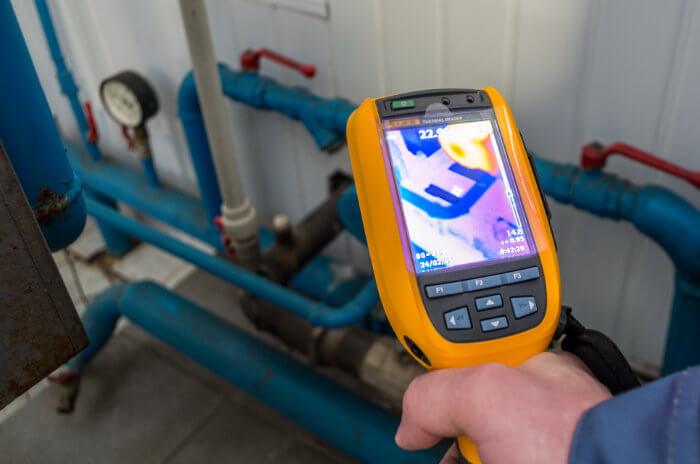
An infrared camera measures surface temperature. That is the whole of what it does, and every conclusion past that point is inference. It is a genuinely powerful instrument once you accept that, and a source of expensive mistakes as soon as you forget it, because a cool patch on a wall is a cool patch on a wall until something else establishes that water put it there.
Quick answer
A thermal camera measures surface temperature and nothing else, so it maps where water has reached rather than pinpointing where it escaped. It is strong on live hot circuits and weak on slow cold leaks in a stable room. The fee covers the survey, the dimensioned extent drawing and the record of the conditions it was taken under, agreed in writing before travel.
What builds the fee for a thermal survey
| Stage of the survey | What sets the fee | What lengthens it |
|---|---|---|
| Establishing whether the conditions can support a survey | Whether a usable temperature differential exists or has to be created | Solar gain, recently washed floors or a building left unheated |
| Driving the relevant circuit to produce a differential | How many zones must be run separately so patterns can be attributed | A system with no zone isolation, so circuits cannot be separated |
| Baselining the normal before calling an anomaly | Size and complexity of the area, and how many elevations are involved | Complex junctions, thermal bridging and heavily serviced ceilings |
| Corroboration against moisture and pressure results | Whether a second method has to agree before a point is marked | A thermal extent that contradicts the pressure result |
| Dimensioned extent drawing and conditions record | How far the record must go for drying or reinstatement to be scoped | A return visit where conditions were unusable on the first |
We do not publish a price list, because the figure is built from the property rather than picked from a menu. The detection fee is confirmed in writing before an engineer travels, and repair is quoted separately once there is a located point to quote against.
The method earns its place on circuits that are actually carrying heat. Flow and return, a hot supply run, an underfloor loop that has been driven deliberately for the purpose: these put a real temperature difference into the structure, and the camera resolves it. A slow cold water leak in a room sitting at a stable temperature often puts no difference in at all, and will read as nothing on a screen while quietly saturating a joist.
We therefore treat thermal as a mapping stage rather than a pinpointing one. It tells you how far water has travelled and which direction it came from, which is exactly what narrows the field for the instrument that will place the breach. For freeholders and managing agents the extent drawing is often the more useful half: a dimensioned record of what is wet, taken under stated conditions on a stated date, is the thing that lets a drying contractor be scoped and a later reading be compared against something.
The fee covers the survey, the dimensioned extent drawing and the conditions record that makes it readable later. It is set by the number of zones and elevations to cover, whether the heating has to be driven to create a usable differential, and whether the building can be brought to survey conditions on the first attempt or needs a second. It is confirmed in writing before travel, and any repair or drying work is a separate quotation from whoever carries it out.
What you get
- High-resolution FLIR thermal cameras detect minute temperature differentials caused by evaporative cooling from moisture.
- Identifies moisture paths within cavity walls, under screeds, and behind tiled surfaces common in London period properties.
- Non-invasive scanning prevents damage to original features in listed buildings and heritage properties.
- Effective for diagnosing leaks in underfloor heating systems, pinpointing breaches in pipework without excavation.
- Creates comprehensive moisture maps for insurance reports, showing exact extent of water damage.
- Real-time diagnostics allow for immediate verification of leak sources during the survey.
How it works
A method, not a guess
01
Decide whether the day can support a survey at all
Temperature differential, how recently the heating has run, solar gain on any external elevation, whether floors have been washed, and what the occupancy has been doing. Where the differential is not there we create it by driving the relevant circuit deliberately, and where it cannot be created we reschedule rather than produce a weak record and charge for it.
02
Establish the normal before hunting the abnormal
Known dry areas are recorded first, along with joist and batten lines, thermal bridging at junctions, and the routes pipework is likely to take. An anomaly only exists relative to a baseline, and a survey that never captured the baseline is producing adjectives rather than readings.
03
Scan to a pattern and record the conditions with every image
Rooms are covered in a set order so nothing is missed and the sequence can be followed later. Each retained image carries ambient temperature, surface temperature, the emissivity assumption and the time. An unlabelled false colour picture is decoration. A labelled one is a measurement somebody else can interrogate.
04
Corroborate before anything is marked
A thermal anomaly is matched against moisture readings taken with the scale and instrument named, and against a pressure decay result on the circuit that would explain it. Only where all three agree does a point get marked. Where the thermal extent and the pressure result contradict each other, the contradiction goes in the report rather than being resolved by preference.
Before you book anyone
Six things to establish before you commission a thermal survey
01
Understand what the camera actually measures
It measures the temperature of the outermost surface it can see. It does not see through walls, floors or screed, and it does not detect water. Everything past surface temperature is inference, and the quality of a thermal survey is the quality of that inference. This is not a reason to avoid the method, which is genuinely powerful in the right conditions. It is a reason to be suspicious of any description of it that involves the phrase seeing through, because a survey sold on that basis was sold on a misunderstanding and will be interpreted on one too.
02
Ask what conditions they need and what they will do if the day does not provide them
Thermal imaging needs a temperature difference to read. On a live heating circuit that difference exists. On a slow cold water leak in a room sitting at a stable temperature it frequently does not, and the survey will find nothing while the joist quietly saturates. Good practice is to create the differential deliberately by driving the relevant circuit alone, and where that is impossible, to reschedule. A firm with no answer to this question will produce images whatever the conditions, and images are not the same as findings.
03
Ask whether the images will carry their conditions
A false colour picture with a caption is decoration. The same picture with ambient temperature, surface temperature, the emissivity assumption and the time recorded against it is a measurement, because it can be repeated, compared and challenged. This matters most when the survey result is negative: a nothing found taken under stated conditions narrows the field and can be compared against a later scan, while a nothing found with no record establishes precisely nothing and cannot be relied on by anybody, including you.
04
Ask what they will corroborate the anomaly with
Cool patches have many parents. Thermal bridging at a junction, a draught through a service penetration, an area of recently washed floor and a genuine leak all read similarly on a screen, and the camera cannot separate them. The corroboration that matters is a moisture reading with the instrument and scale named, and a pressure decay result on the circuit that would have to be failing for the thermal pattern to make sense. Where all three agree you have a finding. Where they do not, the disagreement belongs in the report rather than being resolved by preference.
05
Be clear about the difference between extent and origin
Thermal is at its best telling you how far water has travelled and in which direction, which is exactly the information that narrows the field for the instrument that will place the breach. It is at its weakest being asked to name the breach itself, because under screed or through a floor void water can surface a considerable distance from where it left the pipe. Treated as a mapping stage it earns its fee. Treated as a pinpointing stage it produces openings in the wrong place, which is the single most common way this method wastes money.
06
Decide in advance who the extent drawing is for
For a freeholder or a managing agent the dimensioned map of what is wet is often the more valuable half of the survey, independently of where the leak turns out to be. It is what lets a drying contractor be scoped rather than trusted, and it gives a baseline that later readings can be compared against. If that is the use, say so before the survey, because it changes what gets recorded and how much of the building is covered. A survey scoped to find a leak and a survey scoped to document an extent are not quite the same visit.
Compare like for like
A thermal image is a measurement or it is decoration
An infrared camera reads surface temperature and nothing else, so what separates a useful thermal survey from a folder of colourful pictures is the conditions it was taken in and what was done to corroborate it. Here is how that differs between a camera walk around, a firm pricing the opening that follows, and the approach taken here.
| What to check | A visit that starts by scanning | A firm that finds and opens on one price | London Leak Detection 247 |
|---|---|---|---|
| Conditions on the day | Not assessed. The camera comes out whatever the building is doing, and an image is produced either way. | Not a constraint, because an ambiguous image still supports a recommendation to investigate further. | Differential, heating history, solar gain, recent cleaning and occupancy are checked first. Where no usable differential exists we create one by driving the circuit, and where we cannot we reschedule rather than sell a weak survey. |
| Establishing a baseline | Skipped. Anomalies are called against an impression of what normal looks like. | Skipped for the same reason: precision beyond the opening is not what is being paid for. | Known dry areas, joist and batten lines, junction bridging and likely pipe routes are recorded before anything is called abnormal, because an anomaly only exists relative to something. |
| What the images carry with them | False colour and a caption. Unrepeatable, and impossible to challenge or compare later. | Enough visual material to make the case for opening up. | Ambient and surface temperature, emissivity assumption and time recorded against every retained image, so a later scan can be compared against this one rather than described alongside it. |
| Distinguishing water from temperature | Not attempted. Cool patch reads as leak, and a cold bridge or a draught reads the same way. | Resolved in favour of opening, since that is the conclusion the commercial structure prefers. | Every anomaly is matched against a moisture reading with the instrument and scale named and against a pressure decay result on the circuit that would explain it. Contradictions are reported rather than quietly resolved. |
| Depth and build up | Ignored, so an absent signal is reported as an absent leak. | Ignored in the other direction: a faint pattern becomes justification for a large opening. | Screed depth, insulation and floor covering are stated as limits of the survey, because a pipe under a floating floor over insulation may not read at all and that silence is not evidence the pipe is sound. |
| What the survey is used for | Presented as a pinpointing method, which it is not. | Presented as sufficient grounds to start cutting. | Used as the mapping stage. It defines the extent of what is wet and narrows the field, and a second method places the breach before anything is marked or specified. |
Recurring questions
The arguments that come up again and again
Thermal imaging attracts more confident misinformation than any other detection method, largely because the output looks so persuasive. The recurring themes in public discussion are consistent, and the useful ones are all about the gap between an image and a conclusion.
People trying leak detection with a phone attachment
Consumer thermal attachments are now cheap and the threads about them are a good natural experiment. They reliably show underfloor pipe runs on a driven system, and they reliably mislead on everything else, because the resolution and thermal sensitivity are well below what is needed to separate a genuine anomaly from normal variation. Our take: the equipment is the easy part. Knowing what to discount, having a baseline for normal, and having a second method to agree with is the survey. Without those, the picture is an interesting picture.
Surveys that produced images and no conclusion
A recurring complaint involves a folder of colourful pictures, a fee and no actionable outcome. Read closely, most of these describe a scan taken in conditions that could not have supported a result: an unheated property, a hot afternoon on a south elevation, a floor mopped that morning. Our take: the failure was in booking the day, not in the camera. A firm that assesses conditions and postpones is doing the more expensive right thing, because a survey taken in unusable conditions gets relied on for months.
Arguments over whether thermal can find a cold water leak
Both confident answers appear regularly and both are wrong. A cold leak can read, through evaporative cooling of a surface, where there is enough air movement and enough water. A slow cold leak inside a stable structure frequently cannot. Our take: this is exactly why the method belongs after elimination rather than before it. If pressure decay has already established that the cold supply is the failing circuit, a thermal survey has a target and a reason to expect a signal. Without that, an absent reading is uninterpretable.
Homeowners whose boiler loses pressure with nothing visibly wet
This is the most repeated leak scenario in UK discussion, and the regular contributors answer it with a free test before any money is spent: close the boiler isolation valves overnight and see whether the gauge still falls. A large proportion of these threads end at a component inside the appliance rather than a pipe anywhere in the building. Our take: the instinct is right and the same step belongs at the start of any professional survey. Sending a thermal camera to a property whose fault is a waterlogged expansion vessel produces images of a perfectly healthy floor.
Disputes about whether a thermal report was good enough to act on
Where these threads have enough detail to judge, the reports being argued about almost always lack the same things: no stated conditions, no baseline, no corroborating moisture or pressure data, and no dimensioned position. Our take: those four omissions are what make a report unusable by a third party, whether that party is a contractor, a freeholder or a leaseholder being asked to contribute. The images are the least important part of the document.
Questions
Asked before every booking
Can the camera see through a wall or a floor?
No, and any survey sold on that basis is being sold on a misunderstanding. The camera reads the outermost surface it can see. What reaches that surface is heat that has conducted through everything in between, which means depth, insulation, screed thickness and floor covering all blur and delay the signal. A pipe under thin timber may read clearly. The same pipe under a floating floor over insulation may not read at all, and that absence is not evidence that the pipe is sound.
We had a thermal survey that found nothing. Was it wasted?
That depends entirely on whether the conditions were recorded. A negative result taken under stated conditions is real evidence: it narrows what remains and it can be compared against a later scan. A negative result with no record of ambient temperature, differential, heating history or instrument settings cannot be repeated or challenged, so it establishes nothing. When we read previous surveys, that record is the first thing we look for.
Why do you run the heating before scanning?
Because the method needs a difference to read and we would rather manufacture one deliberately than hope the building supplies it. Driving the suspect circuit alone while the others stay closed does two things at once: it puts heat into the run we care about, and it means any pattern that appears can be attributed to that circuit rather than to the one next to it. Scanning a cold building and reporting nothing found is not a survey result.
Is a thermal image enough for a contractor to cut to?
It is enough to decide where to investigate, not enough to authorise an opening. Thermal shows where water has arrived at a surface, and under screed or through a floor void water can surface a considerable distance from where it left the pipe. The opening gets specified once a second independent method agrees, and the point is dimensioned from two fixed features so the person with the saw is not interpreting a colour gradient.
What would make you postpone rather than survey?
Strong solar gain on the elevation in question, floors washed or cleaned that morning, an underfloor system that has been running flat out so the whole slab reads warm, or a property that has been unheated long enough that nothing differs from anything. In each case the images would look convincing and mean very little. Postponing costs a day. A survey taken in unusable conditions gets relied on for months.
How much does a thermal imaging survey cost in London?
There is no published figure here because the work varies more than the label suggests: the number of zones and elevations to cover, whether the heating has to be driven to create a usable differential, and whether the building can be brought to survey conditions on the first attempt all move it. As a market reference, Checkatrade's published UK figures put leak detection at an average of £162, a typical range of £115 to £234 and a full spread of £80 to £1,600, with hourly diagnostic rates of £95 to £145. Our fee covers the survey, the dimensioned extent drawing and the conditions record, and is confirmed in writing before travel.
Can a thermal camera see a leak behind a wall?
It can sometimes see the effect of one on the surface of that wall, which is a different claim. Heat has to conduct from the pipe through everything in between to reach a surface the camera can view, so depth, insulation and finish all attenuate and delay the signal. A pipe behind thin plaster on a solid wall may read clearly. The same pipe behind a dry lined cavity may not read at all, and that absence is not evidence the pipe is sound.
Can thermal imaging tell the difference between a leak and rising damp?
Not on its own, because both can present as a cooler area. What separates them is pattern and corroboration: a supply or heating leak usually has a source geometry that relates to a pipe route and a circuit that fails a decay test, while ground related moisture typically presents as a band related to a level rather than to a run. Moisture readings taken at height intervals, and a pressure result on the circuits, are what settle it.
Do you need the heating on for the survey?
Usually yes, and often on in a specific way. Driving the suspect circuit alone while the others stay closed puts heat into the run we care about and means any pattern that appears can be attributed to that circuit rather than the one beside it. If a property has been unheated for a long period, we would rather arrange for it to be heated and attend afterwards than scan a building with nothing to read.
How long does a thermal survey take?
The scanning is the quick part. Assessing whether the conditions can support a result, driving circuits to create a differential, recording a baseline of known dry areas, and then corroborating each anomaly against moisture and pressure data take most of the visit. A single zone flat is a short job. A house with several heated zones and more than one elevation to consider is not.
What should a thermal report contain?
The conditions the survey was taken under including ambient temperature and heating history, a baseline of areas established as normal, retained images each carrying their own temperature data and emissivity assumption, a dimensioned extent of what is wet, the corroborating moisture and pressure results, and an explicit statement of what could not be assessed and why. Those are the parts a third party can act on. The colour images alone are not a report.
London-wide
Covering all 33 boroughs
Related services
UFH Leaks
A failed UFH loop is isolated manifold by manifold, then pinpointed in the screed with thermal imaging and tracer gas rather than by lifting the floor.
Learn moreHeating Leaks
Pressure loss is diagnosed system by system: thermal imaging over flow and return runs, then tracer gas on the circuit that will not hold pressure.
Learn moreLeak Detection
The method follows the building, not the price list: acoustic correlation on mains, thermal on heating runs, tracer gas where neither will reach.
Learn moreWater going somewhere it shouldn’t?
Tell us the symptoms and your postcode. We’ll confirm the visit, the fixed detection fee and the arrival window before you commit to anything.
Book a detection visit