Who Is Responsible for a Thames Water Leak? The Boundary, the Repair and the Rules
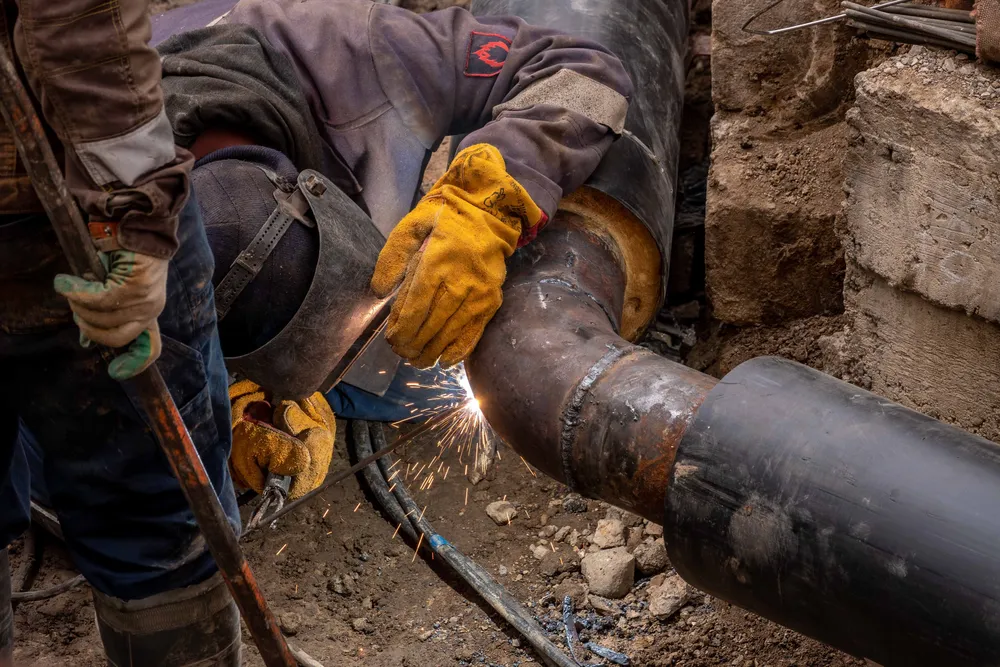
A leak on a Thames Water supply is not one question but three: which pipe failed, who owns that pipe, and who is obliged to repair it. The three answers are set out in published policy and in statute, and they do not always point the same way.
The three pipes, and where responsibility changes hands
Almost every argument about a Thames Water leak comes down to one question that sounds simple and is not: which pipe is it on? A domestic water supply in the Thames Water region is made of three distinct lengths of pipework, and ownership changes twice along the route.
Thames Water sets this out in its pipe responsibility guidance and in more detail in its Household Customer Side Leakage Code of Practice. The company is responsible for the water mains that carry water around the region, and for the communication pipe, which is the length linking your supply pipe to the main. Everything from the boundary of your property inwards, including the underground supply pipe under your garden or driveway and all internal plumbing and fittings, is yours.
Ofwat, the economic regulator, describes the same division in the same terms: mains distribute water around the network, communication pipes carry water between the main and the boundary of private property, and supply pipes run from the boundary to the first fitting or stop tap inside the property. Ofwat is explicit that the owner's duty covers leak detection, repair and replacement, not merely repair when something bursts.
The external stoptap is apparatus, not a boundary line
The stoptap in the footpath is the single most misread object in this whole subject. Thames Water's code of practice states that external stoptaps or stopcocks are apparatus belonging to the company, installed on each service pipe to control flow, and that the stoptap must be positioned as near as reasonably practicable to the boundary of the street. Ofwat puts it more carefully still: where a company stop tap has been fitted, it will normally mark the end of company pipework and the start of the owner's, and not all properties have one.
Normally is doing real work in that sentence. A stoptap sited inside a front garden does not move the boundary. Nor does the meter. Thames Water states plainly that meters are apparatus belonging to the company, usually but not always fitted in the same location as the external stoptap, and that the position of the meter does not determine pipe ownership or responsibility. If someone tells you the leak is yours because it is on your side of the meter, that is not the test.
Where your supply pipe crosses someone else's land
Older London terraces frequently have supply pipes running under a neighbour's garden, a shared path or an access road. This does not transfer ownership. Thames Water's code of practice is direct on the point: if your supply pipe crosses land belonging to someone else, you are responsible for the pipe up to the point at which it connects to the company's communication pipe. You can therefore be liable for excavating ground you do not own, which is a negotiation with the landowner rather than with the water company.
| Section of pipework | Who owns it | Who repairs it | Who pays |
|---|---|---|---|
| Water main in the highway | Thames Water | Thames Water | Thames Water |
| Communication pipe, main to boundary | Thames Water | Thames Water | Thames Water |
| External stoptap and meter | Thames Water apparatus | Thames Water | Thames Water |
| Supply pipe, boundary to the building | Property owner | Owner arranges | Owner |
| Supply pipe crossing third party land | Property owner | Owner arranges, with landowner consent | Owner |
| Internal plumbing beyond the inside stopcock | Property owner | Owner arranges | Owner |
What Thames Water repairs, and what it leaves to you
Thames Water's published position on leaks at home is unambiguous: leaks in your home and garden are your responsibility to fix. Where a leak is confirmed on your side of the boundary the company will write to you, and the obligation to arrange repair sits with you.
The company's guidance on arranging repair recommends a WaterSafe approved plumber for visible or internal leaks and a leak detection specialist for hidden leaks or anything outside the building, noting that approved contractors are recognised through water company schemes including APLUS, WaterMark and WIAPS. Thames Water states that your contract is with that contractor, not with the company, and asks for a certificate of water regulations compliance once the work is done. Where a non-approved plumber is used it reserves the right to inspect the work and charge for further repairs if the standard is not met.
There is one qualified exception. Thames Water's code of practice says that although the supply pipe remains your responsibility to maintain, the company will help fix a leak at its discretion for customers within its Priority Services Register categories or on its WaterHelp or WaterSure schemes, and will also step in where there is a risk to life or to the supply network. Where it does so, it will repair the supply pipe up to where it enters the building but will not work on pipework underneath a building. In a block of flats that means the pipe is repaired to the point it enters the main structure and no further, not to an individual flat. Repairs and replacements carried out this way are guaranteed for two years under normal conditions of use, and the pipe stays the customer's responsibility regardless.
The lead pipe replacement scheme
The one thing Thames Water does replace at its own cost is the communication pipe under its lead pipe replacement scheme. The scheme is conditional and sequenced: the property must pre-date 1970, lead supply pipework must be suspected, the outside stop valve must have been located, and the customer must first arrange replacement of their own internal and supply pipework before the company replaces its section, evidenced by a reconnection survey or an approved plumber's certificate. Small bores are upgraded to the 25mm industry standard.
If you are trying to work out which side of the boundary a leak sits on before any of this becomes relevant, our underground leak detection service exists precisely to answer that question without excavating to find out.
Shared supply pipes and joint responsibility
A single supply pipe sometimes serves two or more properties. Thames Water calls this a shared supply and notes that it is more common where buildings sit close together in a side by side layout, such as a terraced street. The rule the company applies is a split one: you are responsible for maintaining the part of the pipe that supplies only your property, and you and your neighbours have joint responsibility for maintaining the shared part.
Joint responsibility is a maintenance obligation, not an automatic cost split, and the practical difficulty is that nobody can apportion anything until the leak has been located on one section or the other. A shared supply leak that has not been located is a dispute; a shared supply leak located at a named point on a named branch is an invoice. That is the entire value of a survey in this situation, and it is why we treat shared supplies as a location problem before they are a liability problem. The same logic applies to underground supply pipe liability generally.
| Shared supply scenario | Who is responsible | What settles it |
|---|---|---|
| Leak on the common length before any branch | Joint, between all properties served | Location fixed on the common run |
| Leak on the spur serving one property only | That property owner alone | Location fixed past the tee |
| Leak between the main and the boundary | Thames Water | Location fixed on the communication pipe |
| Leak under a neighbour's land on your spur | You, with access to negotiate | Location plus a plan of the run |
The four week rule and Section 75 of the Water Industry Act 1991
Thames Water requires a leak on your property to be fixed within four weeks of you finding it or of the company reporting it to you. That is a policy period, not a statutory one, but it is the period after which the statutory machinery starts.
The statute is section 75 of the Water Industry Act 1991. Where a water undertaker has reason to believe that water supplied to premises is being or is likely to be wasted, misused or contaminated, it may serve written notice on the consumer specifying the steps required and allowing a period for compliance of not less than seven days beginning with the day after service. If the consumer does not comply, the undertaker may take those steps itself and recover the expenses reasonably incurred from the person on whom the notice was served. In an emergency it may disconnect the service pipe or cut off the supply first and give notice afterwards. Failure by the undertaker to serve the required notice is itself an offence.
What a Waste of Water Notice actually does
Thames Water's code of practice describes its own use of that power. Where a formal notice has been issued and the repair has not been carried out, the company will undertake an enforced repair, arrange for the works through its contractors and recover all costs including administration charges. If access is refused it may charge for the wasted visit and may apply to the Magistrates Court for a right of entry warrant. Where the issue is an emergency, for example a serious risk of flooding or to public health, it may cut off the supply. It may also disconnect where the property appears to be unoccupied and no repair work has taken place.
There is a billing consequence as well, and it is the one most people miss. Thames Water states that once a Section 75 notice has been served it will no longer be able to cover all the costs of the leak on your bill if you are on a meter, and the eligibility rules for a leak allowance exclude any leak fixed under Section 75 outright. Letting the four weeks run is therefore not a neutral delay. It converts a recoverable cost into an unrecoverable one.
| Stage | What happens | Legal or policy basis | Cost consequence |
|---|---|---|---|
| Leak identified | You are notified, or you report it | Thames Water leakage code of practice | None yet |
| Four weeks to repair | You arrange detection and repair | Thames Water published policy | Leak allowance remains available |
| Formal notice served | Written notice specifying steps and a date | Water Industry Act 1991, s.75 | Allowance eligibility lost |
| Enforced repair | Thames Water's contractors carry out the work | Water Industry Act 1991, s.75 | Full costs plus administration charges |
| Access refused | Charge for wasted visit, then warrant sought | Magistrates Court right of entry | Additional charges |
| Emergency or unoccupied property | Supply may be cut off | Water Industry Act 1991, s.75 | Restoration conditional on repair |
Proving which side of the boundary the leak is on
None of the rules above help until somebody establishes where the water is escaping. On a domestic supply this is a sequence of eliminations rather than a search, and it can normally be done without breaking any ground.
- Close every outlet inside the property, confirm cisterns are not filling, and take a meter reading. Leave it thirty minutes and read again. Movement with everything closed means water is being lost downstream of the meter. Our guide to reading your water meter to check for a leak sets out the method in full.
- Close the internal stopcock and repeat the test. If the meter still moves, the loss is between the meter and the internal stopcock, which is the buried supply pipe. If it stops, the loss is in the internal plumbing.
- Close the external stoptap and observe whether the ground recovers. Persistent surfacing water with the property isolated points at the communication pipe, which is Thames Water's to repair.
- Where the supply pipe is metal and pressurised, acoustic listening and correlation between two contact points will usually place the escape to within a short length of pipe. On modern MDPE the acoustic signature is far weaker and the survey moves to ground microphone sweeps and tracer gas.
The point of running these in order is that each step produces a written negative that is as useful as the positive. A report stating that the internal plumbing was eliminated by a static meter with the stopcock closed is evidence; a report stating that a leak was found is an assertion. The same reasoning is set out at length in our note on cause and origin reporting.
Getting the decision in writing
Where the leak turns out to be on Thames Water's side of the boundary, or where the company disputes that it is, the thing that matters is a written record of what was decided and on what basis. Verbal assurances from a visiting operative do not survive a later billing argument.
What to ask Thames Water for in writing
- The job or reference number for the visit, and the date and time of attendance.
- A statement of which pipe the leak was found on, expressed as main, communication pipe or supply pipe, not as a street address.
- Confirmation of whether an external stoptap exists at the property and where it is sited.
- Whether the property is on a shared supply and, if so, which properties are served.
- If a notice has been served, a copy of it, the section relied on and the date for compliance.
- If a leak was repaired by the company on your side of the boundary, confirmation of the two year guarantee and what was replaced rather than repaired.
If Thames Water's answer is wrong or the matter stalls, the escalation route is its own complaints process first, and then the Consumer Council for Water, which the company names in its code of practice as the independent body for water consumers in England and which can be approached once the issue is over eight weeks old or the internal process is exhausted. For the mechanics of raising the original report, see our guide to reporting a leak to Thames Water.
One legal point is worth keeping in view throughout. The Water Supply (Water Fittings) Regulations 1999 prohibit installing, altering, disconnecting or using a water fitting in a way that causes or is likely to cause waste, misuse, undue consumption or contamination of water supplied by an undertaker, and prohibit leaving a damaged, worn or faulty fitting in use where it creates those risks. That duty sits on the owner and occupier independently of any notice from Thames Water. A known leak left running is not merely a billing problem.
How we help with this
If the article describes a problem you actually have, these are the visits that deal with it.
- insurance leak claims
What escape of water cover pays for, and what it does not.
- underground water leak detection
Supply pipe leaks under drives, gardens and pavements.
- leak detection in London
Finding a hidden leak without opening the property up first.
Frequently asked questions
Where exactly does Thames Water's responsibility end and mine begin?
Thames Water is responsible for the water main and for the communication pipe, which links the main to the boundary of your property. You are responsible for the supply pipe from the boundary into the building and for all internal plumbing. The external stoptap and the meter are Thames Water apparatus, but their position does not decide ownership. Thames Water states explicitly in its code of practice that the position of the meter does not determine pipe ownership or responsibility, so a leak is not yours simply because it is past the meter.
What happens if I do not repair a leak within four weeks?
Thames Water may serve a formal notice under section 75 of the Water Industry Act 1991. That section allows the undertaker to specify the steps required and to allow a period of not less than seven days for compliance, then to carry out the work itself and recover the expenses reasonably incurred. Thames Water says it will recover all costs including administration charges, may charge for a wasted visit if refused access, and may seek a right of entry warrant. It also states that once a notice is served it will no longer cover all the leak costs on a metered bill.
Who pays when a supply pipe is shared with neighbours?
Thames Water treats a shared supply as two different things at once. You are responsible for maintaining the part of the pipe that serves only your property, and you and your neighbours hold joint responsibility for maintaining the shared part. Nothing can be apportioned until the escape has been located on one section or the other, which is why a located, documented finding matters more here than anywhere else. A leak fixed to a point on the common run is a shared cost; one fixed past your tee is yours alone.
Will Thames Water ever repair a leak on my own supply pipe?
At its discretion, in defined circumstances. Its code of practice says it will help fix a leak for customers in Priority Services Register categories or on the WaterHelp or WaterSure schemes, and where there is a risk to life or to the supply network. Where it does repair, it works up to the point the pipe enters the building and will not work on pipework underneath a building, so in a block it stops at the main structure rather than reaching an individual flat. The pipe remains your responsibility and the repair carries a two year guarantee.
Does my supply pipe stop being mine if it runs under a neighbour's garden?
No. Thames Water's code of practice states that if your supply pipe crosses land belonging to someone else, you remain responsible for the pipe up to the point where it connects to the company's communication pipe. Ownership follows the service, not the soil. The practical consequence is that repairing it may require the landowner's consent for access and excavation, which is a separate negotiation from anything to do with the water company, and one worth resolving before a contractor is booked.
What should I get in writing after a Thames Water visit?
Ask for the job reference and date of attendance, a statement of which pipe the leak was found on expressed as main, communication pipe or supply pipe, confirmation of whether an external stoptap exists and where it sits, and whether the property is on a shared supply. If a notice has been served, ask for a copy and the compliance date. If the company repaired your pipe, ask what was replaced rather than repaired and for confirmation of the two year guarantee.