Hydrostatic Pressure Testing
Swimming Pool Leak Detection London
A pool that is losing water has four candidate systems, and testing them together proves nothing about any of them. The vessel itself, the interior finish or liner, the circulation pipework between pool and plant, and the fittings where those two meet each fail differently and each has to be isolated before an instrument is worth reaching for.
Quick answer
A pool has four candidate systems and the arithmetic comes before the equipment. A bucket test separates evaporation from a genuine loss, and a static level test with the circulation off separates the vessel from the pipework. Only once the loss is attributed to one of them does dye, pressure testing or acoustic work have anything to aim at.
What builds the fee on a pool leak survey
| Stage of the survey | What sets the fee | What lengthens it |
|---|---|---|
| Bucket test to separate evaporation from loss | Whether the pool is indoor or outdoor and how it is covered | Weather that makes an outdoor comparison unreliable |
| Static level test with circulation off | Whether the plant can be stopped for long enough to be meaningful | Pools in use that cannot be left static |
| Isolating and pressure testing each buried line | Number of suction, return and cleaner lines and their valving | Lines with no isolation, which must be tested indirectly |
| Inspecting the vessel, fittings and structure | Size and finish of the pool and the number of penetrations | Liners, movement joints and light housings that need close inspection |
| Locating within the failed line | Pipe material, depth and the surface above the run | Plastic pipework under tiled or landscaped surrounds |
We do not publish a price list, because the figure is built from the property rather than picked from a menu. The detection fee is confirmed in writing before an engineer travels, and repair is quoted separately once there is a located point to quote against.
The work therefore starts with arithmetic, not equipment. A bucket test separates genuine loss from evaporation, which in a heated London pool is not a trivial quantity, and a static level test with the plumbing valved off establishes whether the vessel holds on its own. Where the level only falls with the pump running, the pipework is implicated and the shell may be sound, which is a very different conversation about cost.
Only then does construction choose the method. Gunite and reinforced concrete shells suit hydrophone and correlator work on the structure. Liner and fibreglass pools respond better to pressure decay testing of individual lines with thermal and dye work at suspect fittings. The point of the sequence is that nobody drains a pool or excavates a surround on a hypothesis, because on this kind of asset the wrong opening is the expensive mistake, not the survey.
Pool surveys are scoped on vessel construction, the number of circulation lines to test separately and the access around the surround and plant. The measured loss rate is established first, because it decides whether a full survey is warranted at all.
What you get
- High-sensitivity hydrophones detect the specific acoustic signature of water escaping under pressure from concrete.
- Digital correlators analyse sound waves from multiple sensors to mathematically pinpoint the leak location.
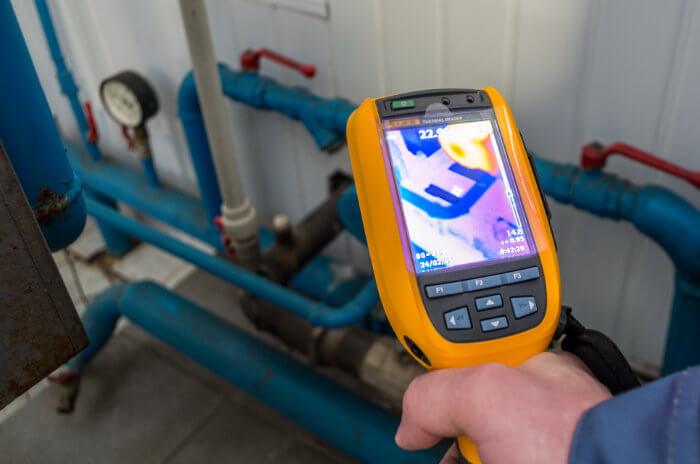
- Thermal imaging cameras visualise cool spots indicating water seepage behind fibreglass shells or tile work.
- Dye testing and pressure decay analysis isolate leaks in plumbing lines independent of the main vessel.
- Real-time moisture mapping for surrounding decking or foundations assesses secondary water damage risk.
- Comprehensive report with diagnostic imagery and recommended repair scope for contractors or insurers.
How it works
A method, not a guess
01
Loss rate quantified against evaporation
A bucket test run over a measured period separates real loss from surface evaporation, and gives a litres per day figure. That number sets expectations for everything after it: a slow structural weep and a failed return line are different magnitudes and different searches.
02
Plumbing isolated from the vessel
Suction and return lines are valved off and the pool is level tested on its own, then each line is pressure decay tested independently. This single split decides whether the investigation is a structural one or a pipework one before any equipment goes near the shell.
03
Method chosen by shell construction
Hydrophones and correlators on concrete and gunite, where escaping water under pressure has a detectable acoustic signature. Pressure work and targeted dye testing at fittings, skimmers and light housings on liner and fibreglass vessels. Thermal scanning of the surround where water has reached the structure.
04
Finding verified before anything is drained or dug
The location is confirmed with a second method, and the report states the loss rate, the system implicated, the method behind the conclusion and the access a contractor would need to price the repair. Draining or excavation follows evidence, never precedes it.
Before you book anyone
Six things to know before you book swimming pool leak detection in London
01
Measure the loss before you commission anything
A bucket of pool water set on a step loses surface water at the same rate the pool does. Compare the two over a measured period and you have separated evaporation from genuine loss, and you have a litres per day figure that tells every subsequent decision how big a problem this is. Heated and indoor pools evaporate more than owners expect, and this half hour of arithmetic occasionally ends the investigation before it starts.
02
Insist the vessel and the pipework are tested separately
A pool is four candidate systems, not one: the shell, the interior finish or liner, the circulation pipework, and the fittings where the two meet. Valve the lines off and level test the vessel on its own, then pressure decay test each line independently. That single split decides whether you are facing a structural repair or a pipework one, and those are different orders of cost. Any quote issued before that split has been done is a quote for an unknown job.
03
Note exactly when the level falls
Loss that only happens while the filtration runs points at the pressure side of the circulation system, typically a return line or a fitting that only fails under pump pressure, and that observation largely exonerates the shell. Loss that continues with the pump off and the lines isolated implicates the vessel or its finish. Keep a simple log of level against pump schedule for a few days before the survey; it is free and it narrows the search more than most equipment will.
04
Ask whether the survey actually needs the pool drained
Usually it does not, and you should be sceptical of a firm that opens with draining. Acoustic work on a concrete or gunite shell needs the pool full, because the loss has to be happening for a hydrophone to hear it, and line testing is done from the plant side. Draining is a repair decision that follows a finding, and on some vessels it carries real structural risk from ground water pressure, so it is not a step to take on a hypothesis.
05
Ask what happens if the first method finds nothing
Shell construction dictates method, and the methods do not substitute for one another. Reinforced concrete and gunite suit hydrophone and correlator work. Liner and fibreglass vessels respond better to pressure testing of individual lines with targeted dye work at skimmers, returns and light housings. Thermal has a role in reading where water has reached the surrounding structure. Establish before booking whether the second and third methods are included or quoted separately.
06
Ask what a pool contractor will be able to price from the report
The report is the deliverable that turns a survey into a repair. It needs the measured loss rate, which system the testing implicated, the method behind that conclusion, the location marked and photographed, and the access required to reach it. A contractor pricing the work needs to know whether they are opening a surround, replacing a section of line or addressing a fitting. A document that says the pool leaks lets nobody quote anything.
Compare like for like
Pool losses are arithmetic before they are equipment
A pool has four candidate systems and a rate of loss that can be measured for the price of a bucket. Almost every expensive pool investigation skipped that measurement. Here is how the sequence differs between a dive and dye visit, a firm pricing the excavation, and the approach taken here.
| What to check | A visit that starts by scanning | A firm that finds and opens on one price | London Leak Detection 247 |
|---|---|---|---|
| Separating evaporation from loss | Not attempted, so normal summer evaporation gets investigated as a leak. | Not attempted, because a confirmed loss is a prerequisite nobody is asking for. | A bucket test run alongside the pool under the same conditions. If the pool and the bucket fall together, there is nothing to find and the job stops there. |
| Splitting vessel from pipework | Skipped, and the search covers everything at once. | Skipped, since a broad search supports a broad scope. | A static level test with the circulation stopped, compared against the loss with it running. A pool that only loses when the plant runs is telling you the fault is on a line rather than in the shell. |
| Testing the buried lines | Left alone, because they are hard to reach. | Excavated speculatively. | Isolated and pressure tested one at a time where valving allows, with the decay recorded, so the failed line is named before any surface is disturbed. |
| Dye testing | Used as the whole method, in water that is still moving. | Used to confirm a conclusion already reached. | Used last, in still water, at fittings and joints the earlier arithmetic has already implicated. Dye in a circulating pool tells you about the circulation. |
| The structure itself | Inspected visually and passed. | Inspected as far as the works require. | Liner, movement joints, light housings, inlets and outlets examined individually, because a pool shell has more penetrations than most people expect and each one is a candidate. |
| What the owner is left with | A suspicion. | A quotation for digging. | A measured rate of loss, the system it was attributed to, the tests that cleared the others, and where relevant a marked point with the surface build up above it stated. |
Recurring questions
The arguments that come up again and again
Pool owners comparing notes online tend to circle the same handful of problems, and very few of them are about equipment. They are about measurement: whether the loss is real, which part of the installation it belongs to, and whether anyone established either of those before a quote for repair work appeared.
Owners arguing about whether the loss is a leak at all
A large share of pool water loss threads resolve into a discussion about evaporation, particularly on heated and indoor installations where owners underestimate how much surface water goes in a week. The test everyone eventually recommends is the bucket comparison, because it isolates the loss evaporation cannot explain. Our take: do this before commissioning anything. A measured litres per day figure turns a vague worry into a number that every later decision, including whether to survey at all, can be taken against.
Questions about whether the pool has to be emptied to find a leak
Owners are frequently told early in the process that the pool will need draining, and the pushback in these discussions is well founded. Acoustic work on a concrete shell requires the pool full because the escape has to be happening to be heard, and circulation lines are tested from the plant side. Our take: draining is a repair decision that follows a confirmed location, and on some vessels it carries real structural risk from ground water pressure once the water is out. Nobody should empty a pool on a hypothesis.
Owners comparing what happens with the pump on and the pump off
The most useful observation in any pool leak thread is also the cheapest: whether the level falls continuously or only while filtration is running. Loss confined to pump operation points at the pressure side of the circulation system and largely clears the shell. Our take: keep a simple log of level against pump schedule for a few days before any survey. It narrows the investigation more than most equipment will, and it costs nothing but attention.
Autofill systems quietly masking a loss for months
A recurring account involves an owner discovering a significant leak only after a water bill arrives, because an automatic top up device had been silently replacing everything that escaped. The advice that follows is always to isolate the autofill before attempting any measurement. Our take: this is also the first thing to check when a survey is booked, because a live autofill makes the bucket test meaningless and can disguise a loss large enough to be damaging the surrounding structure.
Owners asking for a repair price before anyone has tested anything
Requests for a ballpark pool leak repair figure attract a consistent response: nobody can give one, because a shell crack, a failed return line and a leaking skimmer fitting are three different jobs at three different scales. Our take: that response is correct, and it is why the survey splits the vessel from the pipework before anything else happens. Until that split has been made, a repair quote is pricing an unknown, and the only honest thing to quote is the investigation.
Questions
Asked before every booking
How do we know it is a leak and not evaporation?
By measuring both at once. A bucket of pool water set on a step loses surface water at the same rate the pool does, so comparing the two over a fixed period isolates the loss that evaporation does not explain. Heated and indoor pools evaporate more than owners expect, and a meaningful number of suspected leaks stop being suspected at this stage.
Will the pool have to be drained?
Usually not for the survey. Acoustic work on a concrete shell needs the pool full, because the loss has to be happening for it to be heard, and line pressure testing is done from the plant side. Draining is a repair decision made once the location is known, and it is one we would rather you make on evidence, given the structural risks of emptying some vessels.
The level only drops when the filtration is running. What does that indicate?
It points strongly at the pressure side of the circulation system, typically a return line or a fitting that only leaks when the pump puts it under pressure. It is useful information because it largely exonerates the shell. Conversely, loss that continues with the pump off and the lines isolated implicates the vessel or its finish.
Our pool is in a basement. Does that change the survey?
It changes what is at stake around it more than it changes the method. The loss has somewhere to go, into the surrounding structure and plant room, so moisture mapping of adjacent construction runs alongside the pool testing to record how far water has travelled. Acoustic work can also be harder in a plant space, so we test with circulation off where the signal needs it.
What does the report need to contain for a contractor to quote from it?
The measured loss rate, which system the testing implicated, the method that established it, the location marked and photographed, and the access required to reach it. A pool contractor pricing a repair needs to know whether they are opening a surround, replacing a section of line or addressing a fitting, and a report that only says the pool leaks does not let anyone price anything.
How do I tell a leak from evaporation?
Run a bucket test. Fill a bucket with pool water, set it on a step so it sits at the same temperature and exposure as the pool, mark both levels and compare them after a measured period with the pump schedule unchanged. Evaporation affects both equally, so any additional drop in the pool is genuine loss. Heated and indoor pools evaporate more than most owners expect, and this test regularly ends an investigation before any equipment is booked.
Does the pool have to be drained for leak detection?
Normally not, and you should question a firm that suggests it early. Acoustic work on a concrete or gunite shell requires the pool full, because the escape has to be happening for a hydrophone to detect it, and circulation lines are pressure tested from the plant side. Draining is a repair decision that should follow a confirmed location, and on some vessels it carries genuine structural risk from ground water pressure once the water is removed.
The level only drops when the filtration is running. What does that tell you?
It points firmly at the pressure side of the circulation system, most often a return line or a fitting that only leaks when the pump loads it, and it largely clears the shell. The converse is equally informative: loss that continues with the pump off and the lines valved off implicates the vessel or its interior finish. Logging level against pump schedule for a few days before the survey narrows the search considerably at no cost.
Can a leak be found under mosaic tile or in a gunite shell?
Yes. Water escaping under pressure through fine cracks produces a high frequency acoustic signature that carries through hard tile beds and reinforced concrete, which is why hydrophones and correlators are the primary tools on these constructions. Thermal scanning of the surround and structure supports the finding by showing where water has reached, and a targeted dye test at a suspect point can confirm it before anything is broken out.
What should a pool leak report contain?
The measured loss rate in litres per day, which of the four systems the testing implicated, the method that established it, the location marked and photographed, and the access a contractor would need to reach it. Findings that clear a system should be stated as plainly as the one that identifies the fault, because knowing the shell is sound is often what makes a repair affordable rather than catastrophic.
London-wide
Covering all 33 boroughs
Related services
Underground Leaks
Correlators and ground microphones fix a buried supply leak to a single point beneath London gardens, drives and slabs, before anything is excavated.
Learn moreTracer Gas
Hydrogen and nitrogen tracer gas reaches what sound cannot: screeded UFH loops, buried supply runs and low-pressure pipework in London buildings.
Learn moreLeak Detection
The method follows the building, not the price list: acoustic correlation on mains, thermal on heating runs, tracer gas where neither will reach.
Learn moreWater going somewhere it shouldn’t?
Tell us the symptoms and your postcode. We’ll confirm the visit, the fixed detection fee and the arrival window before you commit to anything.
Book a detection visit