Technology-Driven Diagnostics
Leak Detection London
A leak survey is an elimination exercise before it is a detection exercise. The instrument comes last, because until you know which circuit is losing water and what the floor is made of, choosing between acoustic, thermal and tracer gas is guesswork with expensive equipment attached.
Quick answer
A leak survey is an elimination exercise before it is a detection one. Each wet circuit is isolated and pressure decay tested in turn to establish which system is actually losing water, and only then does the floor construction and pipe material decide which instrument places the breach. The fee follows how much elimination the building needs and is agreed in writing before an engineer travels.
What builds the survey fee on a London property
| Stage of the survey | What sets the fee | What lengthens it |
|---|---|---|
| Circuit isolation and pressure decay testing | How many separate wet systems there are to eliminate one at a time | Valves that are seized, unlabelled or buried behind fitted units |
| Reading the construction before choosing a method | Floor build up, pipe material and whether either is documented | Unknown or mixed pipework from successive refits |
| Locating with the instrument the building indicates | Whether one method suffices or a second has to be carried as backup | Plastic pipe, deep screed and anything that mutes the primary signal |
| Corroboration by a second independent method | Whether the point has to stand up to somebody who was not present | A first and second reading that disagree and have to be resolved |
| The written record and the marked point | How far the document has to go for the use it is put to | Multiple demises, absent access and limitations that must be stated |
We do not publish a price list, because the figure is built from the property rather than picked from a menu. The detection fee is confirmed in writing before an engineer travels, and repair is quoted separately once there is a located point to quote against.
So we start with pressure. Each heating circuit, the hot and cold supply, the incoming main and the boiler itself are isolated and decay tested separately. That single step decides most jobs: it tells you which system failed, how fast, and often that the fault is a component rather than a pipe at all. Only once a circuit has failed does the construction choose the method, copper and steel toward acoustic correlation, plastic and screed toward tracer gas, a pressurised hot run toward thermal.
What you receive is a point on the building and a document saying how each conclusion was reached. Landlords, freeholders and managing agents rely on that second part, because the person who has to act on the finding, whether that is a contractor pricing the opening up or a leaseholder being asked to pay, was almost never in the room when the reading was taken.
The survey fee follows how much elimination the building needs: the number of circuits to isolate, the pipe material, the access involved and the depth of written record required. It is confirmed in writing before an engineer travels.
What you get
- Acoustic correlation for high-rise and large commercial buildings: pinpoints leaks in pressurised systems via sound-wave analysis.
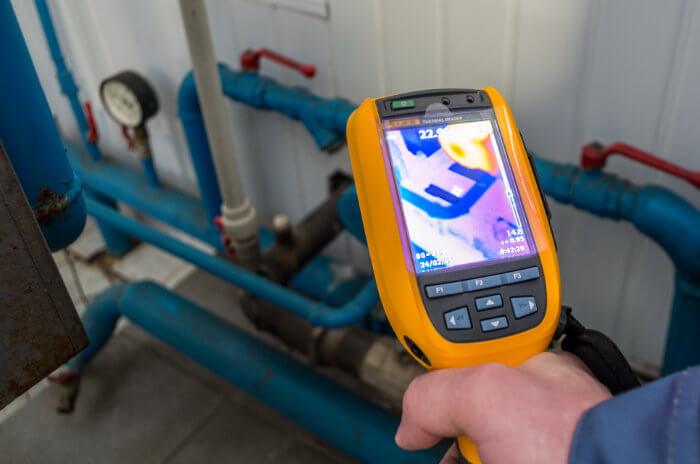
- Thermal imaging cameras for underfloor heating and slab leaks: visualises temperature differentials caused by escaping water.
- Tracer gas (hydrogen) for voids and complex drainage: inert gas sensors locate leaks in inaccessible sub-floor or cavity wall spaces.
- Moisture mapping with hygrometers and borescopes: quantifies dampness spread and inspects inside walls without destructive exploration.
- Pre-purchase leak surveys for landlords: due-diligence reports on plumbing integrity in Victorian conversions and modern apartment blocks.
- Commercial system integrity checks: pressure testing and continuous monitoring for retail units and office buildings to prevent business interruption.
How it works
A method, not a guess
01
Circuit isolation and pressure decay testing
Heating zones, supply, main and boiler are tested one at a time rather than as a single system. We record which circuit fails and the rate it falls at, which sets the scale of the breach and rules out the components that mimic a leak.
02
Construction read, then instrument chosen
Floor build-up, pipe material and access are established before anything is switched on. Suspended timber voids favour tracer gas, cast and buried metal runs favour acoustic correlation, live hot circuits under screed favour thermal. The building picks, not the engineer's preference.
03
Corroboration before a point is marked
No location is signed off on a single reading. A thermal anomaly is a temperature and a moisture peak is where water surfaced, which under screed can be rooms away from the breach. A second independent method has to agree before we mark the floor.
04
Findings written for the person who was not there
Cause and origin, the method behind each conclusion, moisture readings by room with the scale named, photographs keyed to the marked point, and the scope of opening up required. Limits of the survey are stated too, including any circuit we could not isolate.
Before you book anyone
6 things to check before you book leak detection in London
01
Ask what gets tested before anything gets scanned
The single most useful question you can put to a detection firm is what happens in the first hour. The answer should be pressure decay testing, circuit by circuit, with the boiler valved off, because that establishes which system is actually losing water. A firm that opens by walking the property with a thermal camera has skipped the step that tells them where to point it. Scanning first and eliminating afterwards is the sequence that produces surveys ending in the words somewhere in this area.
02
Get their definition of found in writing
No find no fee is only as good as the word found. Published terms in this industry vary enormously: some firms treat a leak as located once it has been narrowed to a five metre square, which in most London flats is a whole room, and a room is not something a repair can be cut to. Ask for the definition before you book, and ask it of everyone you are comparing. A firm that commits to a point you can core to is describing a different service from one that commits to an area.
03
Find out which methods are on the van and which are a second visit
Acoustic work is quick and precise on copper and steel and close to useless on plastic, which is most London pipework installed since the 1990s. Thermal shows you temperature, which is a proxy for water and not water itself. Tracer gas reaches what neither can, but needs the circuit drained first. Any one of them alone will fail on some proportion of jobs. The practical question is not whether a firm owns all three, it is whether all three arrive on the first visit or generate a second chargeable one.
04
Establish who actually owns the pipe before you commission anything
A meter that turns with every internal outlet closed points outside the building, and outside the building the boundary matters: the communication pipe up to your property line belongs to the water company, and suppliers including Thames Water will often repair or contribute to a first leak on the external supply pipe. In a flat, communal risers and pipework above your ceiling are usually the freeholder's or a neighbour's responsibility under the lease. Ringing the supplier or notifying the managing agent in writing costs nothing and occasionally removes the need for a survey entirely.
05
Ask whether the report states what was ruled out, not just what was found
A report that names a leak location is worth something. A report that also records which circuits were isolated, which held, what the decay rates were and which parts of the building could not be reached is worth considerably more, because that is the part that survives a challenge. If the finding is ever going to be read by a leaseholder, a freeholder, a contractor or anyone asked to pay for the consequences, the negative results are doing as much work as the positive one.
06
Compare total scope, not headline rates
Checkatrade's published UK figures put leak detection at an average of £162, a typical range of £115 to £234 and a full spread of £80 to £1,600, with hourly diagnostic rates of £95 to £145. That spread is not sloppiness in the data, it is the difference between a single method visit to a one bathroom flat and a full multi-circuit elimination on a house with underfloor heating. A cheap hourly rate is not a cheap survey if the meter runs all day, and a higher fixed figure that includes every method and a written report can be the lower number by the time the job closes. Compare what is included and what happens when the first method fails.
Compare like for like
What separates a leak survey from a look around
Almost every unsatisfactory leak survey fails in the same place, and it is not the equipment. It is the sequence. Below is how the first hour, the choice of method and the written record differ between a visit that reaches for an instrument straight away, a firm whose fee depends on opening a structure, and the way this site works.
| What to check | A visit that starts by scanning | A firm that finds and opens on one price | London Leak Detection 247 |
|---|---|---|---|
| What happens in the first hour | An instrument comes out of the van and the property gets swept. Nothing has established which system is losing water, so the sweep has no target and every warm or damp patch is a candidate. | Often a brisk inspection aimed at agreeing a scope of works, because the commercial value of the visit sits in the opening up rather than in the diagnosis. | Circuits are isolated and pressure decay tested one at a time, with the rate recorded. That single step names the failed system and rules out the components that imitate a pipe leak. |
| What decides which method is used | Whatever the engineer owns and is comfortable with. The instrument is fixed and the building has to fit it, which is the wrong way round. | Whatever produces an agreed opening fastest. Method selection quietly optimises for the next stage of the job rather than for the accuracy of this one. | The construction picks. Pipe material, floor build up and access are established first, then the method follows: metal under pressure toward acoustic, live hot runs toward thermal, screed and plastic toward tracer gas. |
| What counts as found | An area. Frequently a room, described in terms a repair cannot be cut to, which pushes the real diagnosis onto whoever opens the floor. | A place to start cutting. The opening becomes the continuation of the investigation rather than the end of it. | A point dimensioned from two fixed features of the building, marked physically, and agreed by a second independent method before it is written down. |
| What happens when the first method fails | The survey ends. The fee has been earned by attending, and the outcome is that nothing conclusive was established. | Exploratory opening is proposed, which converts a failed diagnosis into chargeable work. | A different method is applied on the same visit wherever the building allows, and where it does not, the report says exactly what remains untested and what would settle it. |
| What happens to a negative result | It disappears. A survey that found nothing typically produces an invoice and little else. | It is unwelcome, because there is nothing to open and therefore nothing to price. | It is written up in the same detail as a positive one. Evidence that a demise holds pressure while loss continues elsewhere is frequently the single most useful thing a leaseholder or an agent can be handed. |
| What the written record contains | A short conclusion and perhaps a photograph, readable only by somebody who was already there. | A scope of works. Useful for pricing the opening, silent on how the conclusion was reached. | Cause and origin, the method behind each conclusion, decay rates by circuit, moisture readings by room with the instrument and scale named, photographs keyed to the marked point, the scope of opening required, and the stated limits of the survey. |
Recurring questions
The arguments that come up again and again
Read enough UK property and DIY discussion and the same five arguments about leak detection come round again: who is supposed to commission it, why a survey found nothing, why two quotes for the same job differ by a factor of ten, and who owns the pipe in the first place. Almost all of them are questions about method and sequence rather than about price.
Leaseholders working out who is supposed to commission a survey
Water arriving through a ceiling from the flat above generates a predictable stalemate: the leaseholder below wants it investigated, the flat above denies a leak, and the managing agent waits for someone to instruct. The practical advice that recurs is to notify the agent in writing immediately, because block policies and lease terms often decide who pays before anyone argues about it. Our take: the fastest route out of that stalemate is a survey that isolates and pressure tests the demised pipework in each flat. Evidence that one side holds pressure while loss continues is what ends the discussion, and a negative result is worth commissioning in its own right.
Homeowners whose boiler loses pressure with nothing visibly wet
This is the single most common leak question we are asked, and the regular contributors now answer it with the same free test before anyone spends money: close the boiler isolation valves overnight and see whether the gauge still falls. A large share of these threads end at a component inside the appliance rather than a pipe anywhere in the building. Our take: this is the right instinct and it belongs at the start of any professional survey too. Elimination of the appliance is an hour of work that decides whether the rest of the survey is worth doing at all.
People comparing quotes that differ by an order of magnitude
Posters routinely report quotes for what sounds like the same job spanning a huge range, and the collective wisdom is that the cheap headline rate rarely stays cheap once the hours accumulate. Checkatrade's published UK figures bear the spread out: an average of £162, a typical range of £115 to £234 and a full range of £80 to £1,600, with hourly diagnostic rates of £95 to £145. Our take: the spread is real and mostly honest, because it reflects how much elimination a building needs. Compare the scope and the definition of a completed survey rather than the opening number.
Complaints about single method visits that found nothing and still charged
A recurring grievance involves an engineer arriving with one instrument, sweeping a room, declaring the leak untraceable and leaving with the fee intact. The advice that follows is always the same: ask what equipment is on the van before booking, and ask what happens when the first method draws a blank. Our take: no single method covers every pipe material and floor construction, which is why a survey should carry acoustic, thermal, tracer gas, moisture mapping and pressure testing as standard rather than as escalating visits.
Confusion over where the property owner's pipe actually starts
Threads about a spinning meter frequently reveal that nobody checked the boundary first. The communication pipe up to the property line belongs to the water company, and suppliers including Thames Water will often repair or contribute towards a first leak on an external supply pipe. Our take: this is a phone call, not a survey, and it is worth making before anyone is instructed. Commissioning detection on a pipe you do not own is a straightforward way to spend a fee you did not need to spend.
Questions
Asked before every booking
Why start with pressure testing instead of a thermal camera?
Because a camera shows you temperature, not water, and on a property with three or four wet systems it will show you plenty of temperature. Pressure decay testing answers a prior question: which system is actually losing anything. Run it first and the imaging has a target. Run the imaging first and you are interpreting warm patches with no idea whether the circuit behind them even fails.
A plumber has already told us where it is. Why re-test everything?
Because a survey that starts from somebody else's conclusion inherits it. The most expensive jobs we attend are the ones where three trades have agreed on a cause nobody instrumented, and the floor has been opened twice on the strength of it. We read previous reports and we will not repeat tests you can show were done properly, but we do not treat an opinion as a result.
How precisely do you locate a leak?
To a point a repair can be cut to, typically within a small area of floor or a single stud bay, and marked physically on the building. This matters because the industry defines finding loosely: some no find no fee terms count a leak as located once it is narrowed to a five metre square, which is most of a room. Ask any firm, including us, what their definition is before you book.
Can a survey establish that a leak is not coming from our flat?
Frequently, yes, and negative findings are written up with the same detail as positive ones. Isolating and pressure testing the demised pipework, then showing it holds while the loss continues, is direct evidence that the source is elsewhere. That is often what a leaseholder or managing agent actually needs before a liability conversation can start.
What do you need from a managing agent before attending?
Access arrangements for the affected flat and, ideally, the one above and the riser cupboard, since a survey that can only reach one side of a party structure is limited from the outset. Plus the property age, floor construction if known, heating type, and any previous reports. We will say up front which parts of the building we need to reach for the finding to be defensible.
What order should a proper leak survey follow?
Elimination, then location, then corroboration, then the written record. Circuits are isolated and pressure decay tested one at a time to establish which system is losing water and to rule out the boiler components that imitate a pipe leak. Only then does the floor construction and pipe material decide the instrument. A point is marked once a second independent method agrees with the first. Any survey that starts with scanning is doing stage two without stage one.
How much does leak detection cost in London?
Checkatrade's published UK figures put leak detection at an average of £162, a typical range of £115 to £234 and a full spread of £80 to £1,600, with hourly diagnostic rates of £95 to £145. We do not publish our own figures because the fee is a function of the property rather than a menu item: the number of circuits to isolate, the pipe material and the depth of written record you need are what move it. The survey fee is confirmed in writing before anyone travels.
How long does a leak detection survey take?
A typical domestic survey runs two to four hours. Straightforward cases resolve faster, particularly where one circuit fails clearly and the pipe is accessible metal. Solid floors take longer because tracer gas needs the circuit drained and needs migration time to surface through the screed, and large or multi-zone properties take longer simply because there is more to eliminate. The aim is a location you can cut to in one visit.
Can a leak be found without lifting floors?
In most cases yes, and that is the entire purpose of the equipment. Acoustic correlation listens for pressurised water escaping through metal pipe, thermal imaging reads the heat signature of a live hot run, tracer gas migrates up through screed and soil to a surface detector, and moisture mapping records how far water has travelled. Floors come up once the point is marked, over a single area, rather than in a line across a room.
Who is responsible for the leaking pipe, me or the water company?
It depends which side of the boundary it sits on. The communication pipe up to your property line belongs to the water company. The supply pipe from the boundary to the building is the property owner's, although suppliers including Thames Water frequently repair or contribute to a first leak on an external supply pipe, so it is worth a call before commissioning anything. Inside a block, communal risers are normally the freeholder's responsibility under the lease while demised pipework is the leaseholder's.
Our boiler keeps losing pressure but nobody can find a leak. Why?
Because there may not be one in the pipework. A waterlogged expansion vessel absorbs pressure with no water leaving the system, and a pressure relief valve discharging to an external pipe loses water where nobody sees it. Both produce exactly this symptom. The test is to close the flow and return valves under the boiler overnight: if pressure still falls with the appliance isolated, the fault is inside it and detection equipment will find nothing because there is nothing to find.
London-wide
Covering all 33 boroughs
Related services
Acoustic Detection
Ground microphones and correlators read the sound a pressurised leak makes through masonry, screed and Victorian pipework across London properties.
Learn moreThermal Imaging
Infrared imaging maps temperature difference, not water, so it is read alongside moisture meter readings before any London floor is opened up.
Learn moreTrace & Access
Trace and access done in a defined order, least invasive first, so the access that follows is one opening in the right place instead of several.
Learn moreWater going somewhere it shouldn’t?
Tell us the symptoms and your postcode. We’ll confirm the visit, the fixed detection fee and the arrival window before you commit to anything.
Book a detection visit