Precision Leak Location
Trace and Access London
Trace and access describes a sequence rather than a product. Something has to be found, something has to be opened to reach it, and something has to be put back. Three different activities, frequently three different trades, and the cost sits overwhelmingly in the middle one.
Quick answer
Trace and access is a sequence, not a product: find it, open to reach it, put it back. The cost sits in the middle step and is decided by the first. An opening cut to a corroborated point is a repair; an opening cut to a damp patch becomes an investigation. The deliverable that governs the outcome is a dimensioned access specification a builder can price consistently.
What builds the fee for trace and access work
| Stage of the survey | What sets the fee | What lengthens it |
|---|---|---|
| Elimination by circuit before anything is located | How many wet systems are in play and can be isolated | Systems that cannot be taken out of service during occupation |
| Locating to a point with corroboration | Whether one method is decisive or a second must agree | Water surfacing a long way from the breach, needing more work to resolve |
| Surveying the build up between surface and pipe | Finish, substrate, depth and what else is routed through it | Protected or unmatched finishes that justify more trace effort |
| Writing the access specification | Opening size the repair needs, and what must not be cut | Multiple services and structure crowding the point |
| Re-testing after exposure and after repair | Whether the exposed defect accounts for the measured loss | A defect that does not explain the loss, so the trace resumes |
We do not publish a price list, because the figure is built from the property rather than picked from a menu. The detection fee is confirmed in writing before an engineer travels, and repair is quoted separately once there is a located point to quote against.
What decides the size of that middle step is entirely upstream. An opening cut to a point that two independent methods agreed on is a repair. An opening cut to a damp patch is an investigation, and investigations have a way of becoming several openings across a room, because water surfaces where the structure lets it rather than where the pipe failed. The discipline that keeps the second from happening is corroboration before anything is marked.
For landlords, freeholders and managing agents, the document that actually governs the outcome is the access specification: a dimensioned instruction saying what to open, how large, through which build up, what to avoid, and what putting it back involves. It tells a builder what to cut, and just as importantly what not to. Without it the scope is decided on site by whoever is holding the tool, and that decision has never yet come out smaller.
The fee covers the trace, the corroboration and the access specification that comes out of it. What moves it is the number of circuits to eliminate, the construction between the surface and the pipe, and how far the written record has to go. Opening up, repair and reinstatement are quoted separately by whoever performs them, which is deliberate: when the same party prices both the finding and the cutting, every uncertainty resolves in favour of a larger opening.
What you get
- Acoustic correlation for pressurised systems in commercial buildings and multi-tenant blocks.
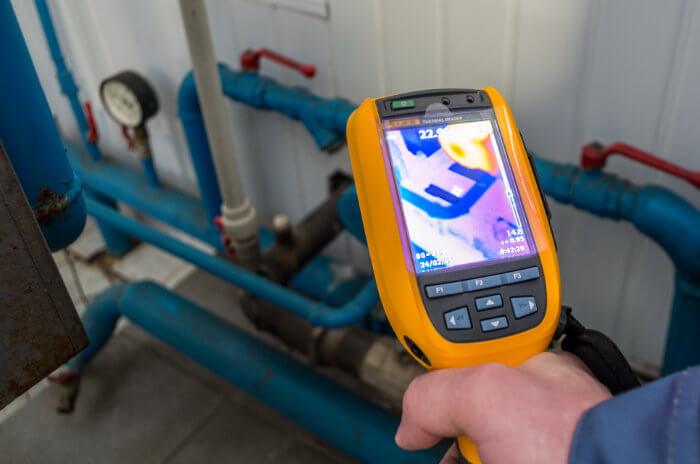
- Thermal imaging cameras to map temperature differentials from underfloor heating leaks or pipework in screed.
- Tracer gas injection (Hydrogen) for pinpointing leaks in complex, non-pressurised waste systems or beneath concrete slabs.
- Non-invasive moisture mapping with penetrating radar to define the extent of water ingress without destructive probing.
- On-site analysis to determine the most effective method sequence for your specific property type and leak symptoms.
- Comprehensive report including detection methodology rationale, evidence, and precise coordinates for remedial work.
How it works
A method, not a guess
01
Trace to a point and corroborate it
Circuits are isolated and pressure decay tested to establish which system is losing water, then the construction decides the locating instrument. Nothing is marked until a second independent method agrees with the first, because the whole value of a tight trace is that it lets the opening be small.
02
Survey what sits between the point and the pipe
Finish, substrate, depth, and what else is in the way: cables, other services, structure, and anything protected or irreplaceable. A point marked without knowing what is behind the surface is only half an instruction, and the half that is missing is the one that determines cost.
03
Write the access specification
Position dimensioned from two fixed features, opening size stated and justified against the work the repair needs rather than the size of the pipe, the layers to be removed named in order, no cut zones identified, and the reinstatement scope described including anything that cannot be matched.
04
Re-test once the pipe is exposed and again after repair
The exposed defect has to account for the loss that was measured, and if it does not, the survey is not finished no matter how satisfying the hole is. After repair the circuit is pressure tested and a moisture baseline is recorded so drying can be measured against a starting figure rather than asserted.
Before you book anyone
Six things to settle before anybody opens a structure
01
Treat trace, access and reinstatement as three separate things
Finding the leak, opening the structure to reach it, and putting the structure back are three activities, frequently performed by three different trades, and they are budgeted as one only by people who have not done it before. The cost sits overwhelmingly in the second and third, and both are determined by the first. That is the whole argument for spending longer on the trace: every centimetre of unnecessary opening is paid for twice, once to make it and once to make it good.
02
Ask who prices the opening, and make sure it is not the same party that located the leak
This is a structural point rather than an accusation. Where the party that decides a structure needs opening is also the party paid for opening it, every uncertainty in the diagnosis has a direction in which to fall. Keeping detection and cutting separately priced removes that, and it has a second benefit: a written specification that an independent contractor can price means you can compare quotations for the same defined work instead of comparing three different descriptions of an unknown job.
03
Insist on corroboration before anything is marked
The most common expensive outcome in this work is an opening cut to a moisture reading that exposed a dry pipe. It happens because moisture tells you where water arrived, not where it left, and under a floor or above a ceiling those can be a long way apart. One reading is a hypothesis. Two independent methods agreeing is a finding. The extra hour spent getting the second is reliably cheaper than the second hole, and where the finish is stone, panelling or anything that will not match, it is not close.
04
Understand what actually determines the size of the opening
Almost everyone assumes it is the accuracy of the mark and it is not. It is the work the repair requires. A press or compression fitting needs room for a tool to close around the pipe, and a section replacement needs enough exposed length either side to make two sound joints. So a point marked to a few centimetres does not produce an opening of a few centimetres. Get the expected size, and the reason for it, written down in advance, because the alternative is that decision being made on site by whoever is holding the tool.
05
Get a specification, not a conversation
The document that governs the outcome is the access specification, and a usable one contains: the position dimensioned from two permanent features rather than from furniture, the opening size with its justification, the build up to be removed layer by layer, the services and structure to avoid, any adjacent pipework or loops marked as no cut zones, the reinstatement scope including an honest note of anything that will not match, and photographs keyed to the marks. Anything less and the contractor is interpreting, which is exactly what the specification exists to prevent.
06
Agree that the exposed defect has to explain the loss
This is the check almost nobody builds in and it is the one that catches the wrong hole. When the pipe is exposed, the defect visible should account for the rate of loss that was measured before anything was opened. A weeping joint does not explain a rapid pressure drop, and a dry section explains nothing at all. Where the two do not match, the trace resumes rather than the opening growing, because an opening that has already failed to find the fault is not evidence about where the fault is.
Compare like for like
The opening is sized upstream, by the trace
Trace and access is three activities and the cost sits in the middle one. What decides how large the opening is turns out to be almost entirely the quality of the step before it. Here is how that comparison looks across a scan first visit, a firm holding both the finding and the cutting, and the separation used here.
| What to check | A visit that starts by scanning | A firm that finds and opens on one price | London Leak Detection 247 |
|---|---|---|---|
| Who prices the opening | Nobody, until someone is on site with a tool and the scope is decided there. | The same party that located the leak, which means every uncertainty in the diagnosis resolves in favour of a larger hole. | A separate contractor, working to a written specification. We keep detection and cutting apart deliberately so the scope is set by the finding rather than by who benefits from it. |
| What the builder is given | A verbal indication and a damp patch. | An internal instruction that nobody outside the firm can price against. | A dimensioned access specification: position from two fixed features, opening size with the reason for it, the layers to be removed in order, services and structure to avoid, no cut zones, and the reinstatement scope including anything that will not match. |
| Corroboration before cutting | None. The mark is a single reading, which is why openings so often expose dry pipe. | None needed for the commercial purpose. | A second independent method has to agree before anything is marked, because the whole value of a tight trace is that it lets the opening stay small. |
| Protected and unmatched finishes | Treated the same as plasterboard. | Treated as a reinstatement line item. | Treated as a reason to spend longer tracing. Where a finish is irreplaceable or cannot be matched, more corroboration is straightforwardly cheaper than opening twice, and the specification says what will not match before the work starts rather than after. |
| After the pipe is exposed | If it is dry, another hole is cut. | If it is dry, the scope grows. | The exposed defect has to account for the loss that was measured. If it does not, the trace resumes rather than the opening expanding, because a hole is not evidence. |
| After the repair | Reinstated and closed. | Reinstated and invoiced. | The circuit is pressure tested and a moisture baseline is recorded by room with the instrument and scale named, so drying can be measured against a starting figure instead of being asserted. |
Recurring questions
The arguments that come up again and again
Public discussion about trace and access work is unusual in that most of the frustration is about scope rather than about competence. The same structural problems recur, and nearly all of them are decided before anybody picks up a tool.
Openings that exposed nothing and were followed by more openings
This is the defining complaint of the genre and the descriptions are strikingly similar: a hole at the damp patch, a dry pipe, a second hole, and a growing sense that nobody is in control of the scope. Our take: the fault is upstream. Cutting to a symptom rather than to a corroborated point is a search conducted through plaster. The protection is a second method agreeing before marking, and a re-test after exposure to confirm the defect explains the measured loss.
Confusion over what the quoted figure included
A recurring pattern involves a price understood to cover the whole problem that turns out to cover only one of the three stages. Our take: the ambiguity is usually genuine rather than deliberate, and it is fixed by asking one question before instructing anybody. Does this cover finding it, opening it, or putting it back, and which of the other two is being quoted by whom. Vagueness at that point compounds.
Owners of period and protected finishes weighing how much trace is justified
Threads about parquet, encaustic tile, lime plaster and panelling circle the same calculation, usually without articulating it. Our take: the calculation is straightforward once stated. Where the finish is irreplaceable, unmatched or listed, the cost of an unnecessary opening is effectively unbounded, so additional corroboration is cheap by comparison. It also changes the specification, which should say whether a covering can be lifted and relaid rather than cut, and should state what will not match before the work begins.
Arguments about who reinstates and to what standard
This surfaces repeatedly after the fact, when a hole has been filled to a standard nobody agreed in advance. Our take: reinstatement scope belongs in the specification alongside the opening, described in terms of the finish and the outcome rather than left as making good. In a managed building it belongs there twice, because the party authorising the work and the party living with the result are frequently not the same person.
Leaseholders trying to establish the leak is not coming from their flat
A common and frustrating position, where the pressure to open something is coming from neighbours or an agent rather than from evidence. Our take: the useful move is to invert the request. Isolating and pressure testing the demised pipework and demonstrating that it holds while the loss continues elsewhere is direct evidence, it requires no opening at all, and a negative finding written up properly is frequently exactly what ends the discussion.
Questions
Asked before every booking
They opened the wall and the pipe behind it was dry. How does that happen?
Almost always because the opening was cut to a symptom rather than to a corroborated point. Water surfaces at the lowest or weakest part of a structure, which under a floor or above a ceiling can be a long way from the breach, and a moisture reading tells you where water has arrived rather than where it left. The protection against it is a second independent method agreeing with the first before anything is marked, and a re-test after exposure to confirm the defect found actually explains the measured loss.
Who does the opening up, and who puts it back?
Generally a builder or a specialist contractor, working to the specification the survey produces, and we keep those roles separate from detection on purpose. The party that finds the leak should not be the party pricing the hole. Where a client wants a single point of contact we will work to a builder they appoint or one they select from more than one quotation, and the specification is written so that any competent contractor can price it consistently.
The floor is stone and the wall is lath and plaster. Does that change the approach?
It changes what a small opening is worth and therefore how much trace effort is justified. Where the finish is irreplaceable, protected or simply impossible to match, spending longer on corroboration is straightforwardly cheaper than opening twice. It also changes the specification: removal sequence, whether a covering can be lifted and relaid rather than cut, and an honest statement of what will not match afterwards go into the document rather than being discovered during the work.
How small can the opening actually be?
It is governed by the repair rather than by the accuracy of the mark, which is the part most people are surprised by. A press or compression fitting needs working room for a tool around the pipe, and a section replacement needs enough exposed length to make two sound joints. So a mark accurate to a few centimetres does not produce an opening of a few centimetres, it produces the smallest opening the repair can physically be carried out through. We state that expected size in advance rather than leaving it to the day.
What should a usable access specification contain?
The position dimensioned from two permanent features rather than from furniture, the opening size with the reason for it, the build up to be removed layer by layer, the services and structure to avoid, the loops or circuits nearby that must not be cut, the reinstatement scope including anything unmatched, and photographs keyed to the marks. Anything less and the person doing the cutting is interpreting, which is the thing the specification exists to prevent.
How much does trace and access work cost in London?
The trace, the opening and the reinstatement are quoted separately here and that is deliberate. Our fee covers the trace, the corroboration and the access specification, and is set by how many circuits have to be eliminated, what sits between the surface and the pipe and how far the record has to go. As a market reference for the detection stage, Checkatrade's published UK figures put leak detection at an average of £162, a typical range of £115 to £234 and a full spread of £80 to £1,600, with hourly diagnostic rates of £95 to £145. The opening and reinstatement are priced by whoever performs them, against the written specification.
What is in an access specification?
The position dimensioned from two permanent features, the opening size with the reason for it, the layers to be removed in order, the services and structure to avoid, any adjacent pipework marked as no cut zones, the reinstatement scope including anything that cannot be matched, and photographs keyed to the marks. The purpose is that a competent contractor who was never on site can price the work and carry it out without interpreting anything.
Who does the opening up?
Generally a builder or a specialist contractor working to the specification, appointed by the client or selected from more than one quotation. We keep that separate from detection on purpose, so the scope of the opening is set by the finding rather than by the party who benefits from it being larger. The specification is written so that quotations from different contractors are actually comparable.
How small can the opening be?
It is governed by the repair rather than by the accuracy of the mark, which surprises most people. A fitting needs working room for a tool around it, and a section replacement needs enough exposed pipe to make two sound joints. We state the expected size in advance and explain the basis, so the decision is not being made on the day by whoever has the saw.
What happens if the pipe behind the opening is dry?
The trace resumes; the opening does not grow. A dry pipe means the corroboration was insufficient or the marked point was wrong, and cutting further from a failed hypothesis compounds the error. That is why the exposed defect is required to account for the rate of loss measured beforehand, and why the measurement is taken before anybody opens anything.
Do you work on listed and period properties?
Yes, and the approach shifts toward more trace and less opening, because that is the economically rational response to a finish that cannot be replaced. In practice it means additional corroboration before marking, a specification that considers lifting and relaying rather than cutting where the covering permits, and an explicit statement of what will not match. Any consents required for works to a listed building are a matter for the owner and the local authority, and we scope our part around them.
London-wide
Covering all 33 boroughs
Related services
Leak Detection
The method follows the building, not the price list: acoustic correlation on mains, thermal on heating runs, tracer gas where neither will reach.
Learn moreLeak Repair
The fault is located with detection equipment before any repair begins, which is why the opening is small and the reinstatement is predictable.
Learn moreHeating Leaks
Pressure loss is diagnosed system by system: thermal imaging over flow and return runs, then tracer gas on the circuit that will not hold pressure.
Learn moreWater going somewhere it shouldn’t?
Tell us the symptoms and your postcode. We’ll confirm the visit, the fixed detection fee and the arrival window before you commit to anything.
Book a detection visit