How Leak Detection Works: The Physical Principles and the Order a Survey Uses Them In
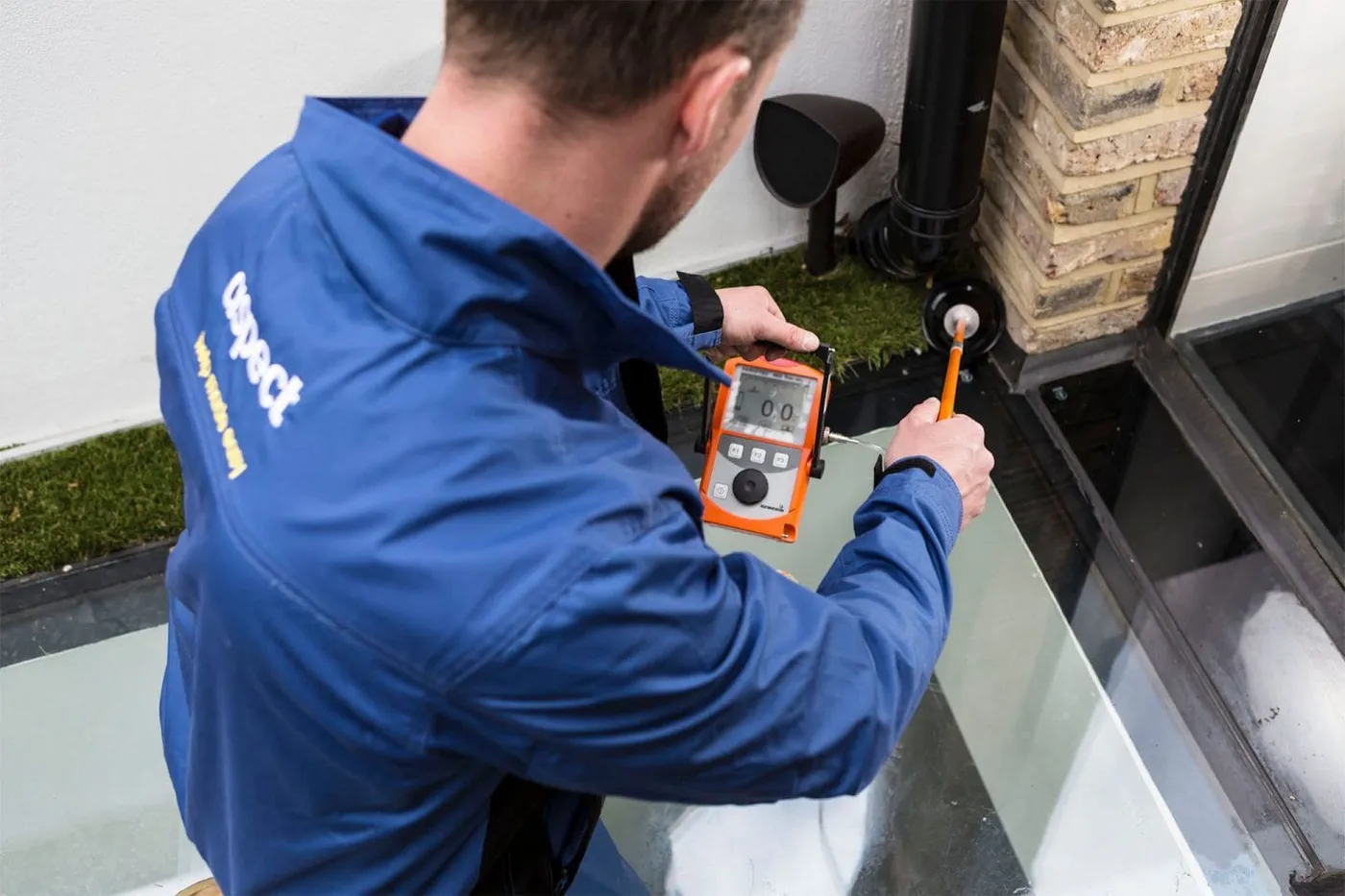
Leak detection is not a search. It is a sequence of eliminations, each one producing a written negative, until only one explanation survives. This is the physics behind each step and the order the steps belong in.
What a leak detection survey is actually trying to establish
A survey that sets out to find a leak usually fails. A survey that sets out to answer four questions in order usually succeeds, because each answer narrows the next question until only one explanation is left standing.
The four questions are: is water being lost at all; if so, from which system; where in that system; and what made it fail. They are separable, they are answered by different instruments, and the order is not negotiable. Asking where before asking whether is how a survey ends up chasing a damp patch that turns out to be condensation, and how a boiler that is losing pressure through a failed expansion vessel gets recorded as a hidden heating leak.
| Question | Method that answers it | What a clean negative looks like |
|---|---|---|
| Is water being lost from the supply? | Timed meter test with all outlets closed | Meter static over a stated interval, with the interval recorded |
| Is the heating system losing water? | Isolation and pressure observation, separate from the supply | Pressure held after isolation, expansion vessel charge checked |
| Is this moisture a leak at all? | Moisture profiling at surface and depth, plus ambient temperature and humidity | Moisture distribution consistent with condensation, not a point source |
| Where is the escape? | Acoustic listening, correlation, thermal imaging, tracer gas | A location, given with the method that produced it |
| What caused the failure? | Inspection on exposure | A mechanism, or an honest statement that exposure is required |
The physical principle behind each method
Every detection method is an inference from a measurable physical quantity to the presence of water where it should not be. Understanding which quantity is being measured tells you immediately where the method will be blind, and that is more useful than any list of advantages. The instrument-by-instrument comparison lives in our companion piece on acoustic, thermal and tracer gas equipment; this section is about the physics underneath it.
Mass balance: water in versus water out
The meter test is the only method that measures the leak itself rather than a proxy for it. Water entering the property with every outlet closed has nowhere legitimate to go, so a moving meter is direct evidence of loss. It is also the only method that can prove a negative outright. Its limitation is that it says nothing about location and nothing about systems that are not fed through the meter at the time of the test, which is why a heating circuit has to be isolated and observed separately rather than folded into the same test.
Sound: what a pressurised escape actually emits
Water forced through a small aperture under pressure becomes turbulent, and that turbulence radiates acoustic energy into the pipe wall and the surrounding material. The pipe itself acts as the transmission line, which is why a listening stick on a stopcock can hear an escape some distance away. The frequency content and the amplitude both depend on the aperture, the pressure differential and the material around the pipe. Metal transmits the signal well over long distances; MDPE and other plastics damp it heavily, and saturated soil damps it further. No pressure, no turbulence, no sound: an unpressurised waste pipe or a gravity drain produces nothing an acoustic instrument can use.
Heat: what a thermal camera measures, and what it does not
A thermal camera measures infrared radiation leaving a surface and converts it to an apparent temperature. It does not see through anything. What it detects is a surface temperature anomaly caused by heat conducted up through the structure from a warm escape, or by evaporative cooling where moisture is drying at the surface. Both require a temperature differential to exist in the first place. A cold water leak into a cold floor void in an unheated room presents no differential and no image. Surface emissivity and reflected radiation from other warm objects produce confident-looking errors, which is why thermographic examination of buildings has its own standard, BS EN 13187, now superseded by BS EN ISO 6781-1, describing it explicitly as a qualitative method.
Gas: why a tracer works where nothing else does
Tracer gas detection depressurises and drains the pipe, fills it with a gas mixture that is lighter than air and chemically inert, and then detects that gas where it emerges at the surface. The usual mixture is hydrogen in nitrogen at a small hydrogen fraction, chosen because hydrogen has the smallest molecular size of any gas and will migrate through screed, soil and joints that water will not. Because the method depends on molecular diffusion rather than on pressure, sound or temperature, it works on the cases the other three cannot reach: unpressurised systems, plastic pipe, deep runs, and leaks too small to make a usable noise.
| Method | Physical quantity measured | What it establishes | What it cannot establish |
|---|---|---|---|
| Timed meter test | Volume through the meter over time | Whether water is being lost, and roughly how fast | Where, or from which pipe |
| System pressure observation | Gauge pressure over time after isolation | Whether a sealed circuit holds | Whether a fall is a leak or an expansion vessel fault |
| Moisture profiling | Electrical resistance or capacitance in the material | Where material is wet, at surface and at depth | Where the water came from |
| Acoustic listening | Vibration and airborne sound from turbulent flow | Presence and approximate position on pressurised pipe | Anything on unpressurised or heavily damped runs |
| Correlation | Time difference of arrival between two sensors | Distance along a known pipe run | Position where the run or material is unknown |
| Thermal imaging | Infrared radiance, converted to apparent surface temperature | Surface anomalies consistent with a warm escape or evaporation | Anything without a temperature differential |
| Tracer gas | Hydrogen concentration at the surface | Emergence point of gas from within the pipe | Cause of failure, and anything while the pipe is in service |
Elimination comes before location
The expensive mistake in this discipline is beginning at the damp patch. Water travels along joists, down cavity ties, across membranes and around the perimeter of a screed before it appears, so the visible symptom is frequently the least informative thing in the building. Stage one of a competent survey is therefore designed to remove whole systems from consideration before anyone points an instrument at a wall.
- Close every outlet, confirm no cistern is filling, read the meter, wait a fixed interval, read again. Record the interval.
- Isolate the heating circuit and watch its pressure independently. Check the expansion vessel charge before calling a falling gauge a leak, and check whether the pressure relief valve is discharging.
- Take moisture readings across the affected area at surface and, where the finish allows, at depth. A surface reading tells you the plaster is wet, not where the water entered.
- Record ambient temperature and relative humidity, and note the ventilation. A damp wall in an unventilated London flat in February is a condensation candidate until proven otherwise, a point we set out at length in damp or leak, how to tell the difference.
- Establish what is actually buried where. Where a floor plan or a service drawing exists, read it before making assumptions about pipe routes.
By the end of stage one a survey should be able to state what the problem is not. Those statements are not filler; they are the evidence that makes the eventual finding credible to a third party who was not present.
How a competent survey sequences the methods
Location work in stage two follows from what stage one established, not from what equipment happens to be in the van. Each step has a purpose and triggers a specific decision about the next step.
| Step | Purpose | Decision it triggers |
|---|---|---|
| Confirm loss and rate | Establish that there is something to find | Static meter and held pressure stops the survey and redirects it to damp diagnosis |
| Identify pipe material and pressure | Decide whether acoustic methods are viable | Metal and pressurised leads to listening and correlation; plastic or unpressurised leads elsewhere |
| Listen at fixed points | Establish presence and direction on the run | A usable signal justifies correlation; silence does not exclude a leak |
| Correlate between two contacts | Convert a signal into a distance along a known run | A distance gives a dig or lift point; an unknown run defeats the method |
| Thermal sweep | Narrow the area where a differential exists | An anomaly focuses the next method; no differential means no conclusion either way |
| Tracer gas on the isolated section | Pinpoint the emergence point without pressure, sound or heat | A surface reading gives the access point for exposure |
| Expose and inspect | Confirm origin and establish cause | Repair scope, and the cause statement in the report |
Two things about this table deserve emphasis. The first is that no step is skipped merely because a later one is more impressive; correlation on a known metal run is faster and cheaper than a tracer gas survey and should be tried first where the conditions allow. The second is that a negative at any step is a result, not a failure, provided it is recorded. Our note on what a leak detection survey involves follows the same sequence through a typical domestic job.
Where each method produces a confident error
Every instrument in this list will, in the right conditions, produce a clear and wrong answer. A survey that does not account for this is not a survey, it is a guess with a certificate attached.
Acoustic equipment picks up pumps, boiler circulators, traffic, adjacent properties on a shared supply, and its own operator. On a terrace with a common supply, a strong signal at your stopcock may belong to next door. Correlation depends on an accurate pipe length and an accurate propagation velocity for the material; get either wrong and the calculated distance is confidently wrong by metres.
Thermal imaging is the method most often over-read. A warm patch over an underfloor heating manifold is the manifold. A cool patch on a wall can be a cold bridge, a different substrate behind the plaster, or a reflection from a window. Emissivity differences between tile, grout and timber will present as temperature differences that are not temperature differences at all.
Moisture meters read conductivity, and conductivity responds to salts, foil-backed plasterboard, metal fixings and recent decoration as readily as to water. A pin meter on a salt-contaminated wall will report saturation in a wall that is dry.
What a defensible finding looks like
The output of all of the above is a written finding that somebody else has to be able to rely on: a loss adjuster, a managing agent, a leaseholder, occasionally a tribunal. A finding is defensible when a competent third party could follow the reasoning without having been there.
- Origin expressed as a physical location, not a room. A joint, a length of pipe, a seal, referenced to a plan or sketch.
- Cause expressed as a mechanism: corrosion, mechanical damage, freezing, failed seal, movement, workmanship. Where cause cannot be determined without exposure, that is stated rather than guessed.
- Every reading with its unit and the time it was taken, and every interval stated. A meter reading without an interval is not a test.
- The methods listed in the order they were used, each with the reason for moving to the next. A list of equipment is a specification; a sequence with reasons is evidence.
- The eliminations, in writing. What was ruled out, and on what measurement.
- Photographs that are timestamped and cross-referenced to the text, and an honest note of anything that could not be accessed.
The reporting standard this implies is set out in full in cause and origin reporting for landlords and managing agents, which is the document a professional reader is actually assessing.
The law and the standards a survey sits inside
Leak detection is not a licensed activity in the United Kingdom, but the work it leads to is regulated, and the regulations shape what a survey may and may not do.
The Water Supply (Water Fittings) Regulations 1999 apply to any person who installs, alters, disconnects or uses a water fitting connected to a supply from a water undertaker, and to anyone who causes or permits it. Regulation 3 prohibits installation or use in a way that causes or is likely to cause waste, misuse, undue consumption or contamination of water, or erroneous measurement, and prohibits leaving a damaged, worn or faulty fitting in use where it creates those risks. A knowingly unrepaired leak is therefore a regulatory matter and not only a cost one.
Schedule 2 of the same Regulations sets the physical requirements a survey is measuring compliance against in practice. Paragraph 3(b) requires pipework to be constructed of materials of sufficient strength and thickness to resist damage from external load, vibration, stress, settlement, pressure surges or temperature fluctuation. Paragraph 5 requires every water fitting to withstand an internal pressure of not less than one and a half times the maximum working pressure, and paragraph 12 applies the same multiple to the system as a whole.
Who is allowed to work on your plumbing
Thames Water's published guidance on arranging a repair recommends a WaterSafe approved plumber for visible and internal work, and an approved contractor for hidden or external leaks, noting that approved contractors are recognised through water company schemes including APLUS, WaterMark and WIAPS. It asks customers to obtain a certificate of water regulations compliance after the work, and states that where a non-approved plumber is used it may inspect the work and charge for further repairs if the standard is not met. Materials and fittings should carry approval, and the WRAS approvals directory is the place that is checked.
Underlying all of it is section 75 of the Water Industry Act 1991, which allows a water undertaker that believes water is being wasted or misused to serve notice specifying the steps required, to allow a period of not less than seven days for compliance, and then to carry out the work itself and recover the expenses reasonably incurred. That is the legal backstop behind every four week repair letter, and it is the reason a survey that produces a dated, defensible finding early is worth more than one that produces a confident opinion late. The equipment behind these methods is described in more detail on our leak detection technology page.
How we help with this
If the article describes a problem you actually have, these are the visits that deal with it.
- our full guide to leak detection
How each method works and when it is the wrong tool for the job.
- leak detection in London
Finding a hidden leak without opening the property up first.
- trace and access surveys
The survey and written report an insurer or loss adjuster asks for.
Frequently asked questions
What is leak detection, in technical terms?
It is a sequence of measurements that infers the presence and position of an escape from physical quantities that can be measured without opening the building. Each method measures one quantity: volume through a meter over time, pressure held in an isolated circuit, sound radiated by turbulent flow, infrared radiance from a surface, or the concentration of a tracer gas emerging through a floor. No single measurement identifies a leak on its own. The finding comes from combining them in an order that eliminates alternatives.
Why does the order the methods are used in matter?
Because each step decides whether the next one is worth doing. A timed meter test with everything closed establishes whether water is being lost at all; if the meter is static, no amount of thermal imaging will find a supply leak because there is not one. Identifying pipe material and pressure decides whether acoustic methods are even viable, since plastic pipe and unpressurised waste produce little or no usable signal. Starting with location work rather than elimination is how surveys end up chasing condensation.
Can a thermal camera see a leak through a floor?
No. A thermal camera measures infrared radiation leaving a surface and converts it to an apparent surface temperature. It detects anomalies caused by heat conducted up through the structure or by evaporative cooling, which means it needs a temperature differential to exist. A cold water leak into a cold void in an unheated room presents no differential and no image. Emissivity variations and reflections from warm objects also produce convincing false readings, which is why thermographic examination of buildings is treated as a qualitative method under its own standard.
When is tracer gas used instead of the other methods?
When the others are physically incapable of working. Tracer gas does not depend on pressure, sound or heat; the pipe is drained and filled with a hydrogen and nitrogen mixture, and hydrogen, being the smallest molecule available, migrates through screed, soil and joints to the surface where it is detected. That makes it the method for plastic pipework, deep or under-slab runs, unpressurised systems and escapes too small to generate usable noise. Its limitation is that the section must be taken out of service first.
What makes a leak detection finding defensible to a third party?
That a competent reader who was not present can follow the reasoning. Origin should be a physical location referenced to a plan, not a room. Cause should be a mechanism, or an honest statement that exposure is needed to determine it. Every reading needs its unit and the time it was taken, every test interval needs to be stated, and the methods should appear in the order used with the reason for moving between them. The eliminations matter as much as the conclusion.
Is there any law governing leak detection work in the UK?
Detection itself is not a licensed activity, but the plumbing it leads to is regulated. The Water Supply (Water Fittings) Regulations 1999 prohibit installing, altering or using a water fitting in a way likely to cause waste, misuse, undue consumption or contamination, and prohibit leaving a faulty fitting in use where it creates those risks. Section 75 of the Water Industry Act 1991 lets a water company serve notice requiring repair, allow at least seven days, then carry out the work and recover its costs.