Boiler Losing Pressure: The Causes, Including the Ones That Are Not Leaks
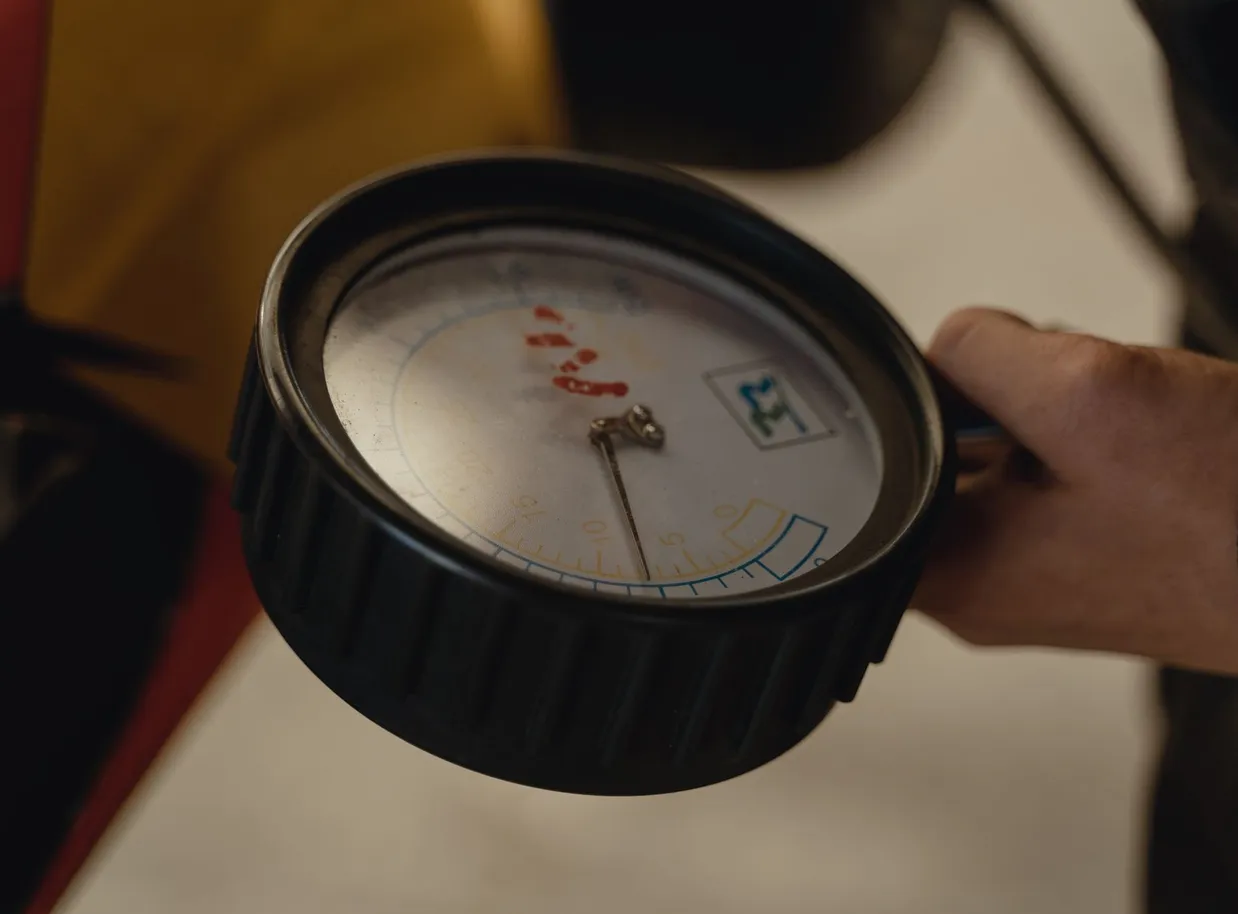
A falling boiler gauge is not automatically a leak. Water leaves a sealed system by three routes that produce no damp patch at all, and topping up treats none of them.
What the pressure gauge is actually measuring
A sealed central heating system is a closed circuit. The same body of water travels round the boiler, the pipework and the radiators indefinitely, and the gauge reads the static pressure of that circuit. It is filled once, through a filling loop, to a cold fill pressure chosen by the installer, commonly between 1.0 and 1.5 bar depending on how far the highest radiator sits above the boiler. Nothing in normal operation consumes water, so on a sound system the needle should sit in the same place year after year.
Two things move the reading even when the system is in perfect health. The first is temperature: water expands as it heats, so a system running hot will read higher than the same system read cold, often by around half a bar. The second is the expansion vessel, which absorbs that expansion so the rise stays modest. The practical consequence is that any useful observation has to compare like with like. Read the gauge from stone cold, at the same point in the week, and write the number and the date down.
What a normal reading looks like
The manufacturer's instructions for the specific appliance are the authority on the correct cold fill figure, because the band printed on the gauge face is generic. Broadly, a cold reading that has drifted below roughly 0.7 bar will usually make the boiler lock out on low pressure, and a hot reading approaching 3 bar is heading for the safety valve. Between those two the system is nominally working, which is why a slow loss can run for months before anyone notices.
| Cold reading | What it usually indicates | First action |
|---|---|---|
| Steady at the installer's fill figure for months | Sealed circuit intact | Record it annually at service |
| Falls slowly over weeks | Small loss, or repeated bleeding of radiators | Log dated cold readings before anything else |
| Falls to zero within days | Active leak, or a safety valve discharging | Check the outside discharge pipe, then investigate |
| Climbs well above 2.5 bar when hot, low when cold | Classic waterlogged expansion vessel signature | Registered engineer to check vessel pre-charge |
The three causes that are not leaks
The phrase people actually type is boiler losing pressure no leak, and it describes a real situation rather than a failure to look properly. Water can leave a sealed system by routes that produce no damp patch and no puddle, because it leaves the building rather than entering the fabric. Three mechanisms account for most of them, and none is fixed by topping up.
Expansion vessel diaphragm failure
An expansion vessel is a steel shell divided by a flexible diaphragm. One side holds an air or nitrogen pre-charge; the other connects to the heating water. As the water expands it pushes against the diaphragm and compresses the gas, which keeps the pressure rise within bounds. Vessels are sized to BS 7074 or BS EN 12828 and manufactured to BS EN 13831, and the pre-charge is normally set at or just below the cold fill pressure so the vessel is ready to accept expansion from the moment the boiler fires.
Over years the pre-charge escapes, usually through the Schrader valve, or the diaphragm hardens and splits. Either way the vessel fills with water and stops working. The system then has nowhere to put its expansion, so pressure climbs steeply as soon as the boiler runs. When it reaches the setting of the safety valve, the valve lifts and dumps water outside. The system cools, the volume that left is gone, and the cold reading is lower than it was. Repeat daily and you have a boiler that loses pressure with no leak anywhere in the house, because the water is going down a copper pipe on an outside wall.
The pressure relief valve discharging outside
The pressure relief valve, usually set at 3 bar and often marked by a red cap, carries out the dumping described above. Its discharge pipe terminates outside, frequently low down on an external wall where nobody goes from one year to the next. This is the most overlooked check in the whole diagnosis and it takes two minutes: find the small copper or plastic pipe near the boiler flue and look at whether the ground beneath it is wet, stained, limescaled or greened.
The valve has a second failure mode that matters. Once it has lifted, debris can be drawn onto the seat, and it may then weep continuously at normal pressure rather than sealing again. That produces a slow, permanent loss with no fault anywhere else. If the pipe outside is dripping, the guide to what a dripping overflow pipe outside means covers how to tell a heating discharge apart from a cistern overflow, which looks similar and means something entirely different.
Automatic air vents and repeated bleeding
Every time a radiator is bled, volume leaves the system and the pressure falls. A household that bleeds radiators every few weeks has a system that loses pressure every few weeks, and that is arithmetic rather than a fault. The fault, if there is one, is whatever keeps producing the air: usually corrosion gassing in an untreated circuit, or air drawn in on the suction side of the pump.
Automatic air vents deserve a separate mention. These small brass devices sit at high points and on the boiler, and use a float to open a port when air collects and close it when water arrives. When the seat or float fails, the vent passes water as well as air, sometimes as a fine spray that evaporates on warm pipework and leaves only a faint white deposit. It is a genuine leak that behaves exactly like no leak at all.
Telling a real leak from a vessel fault
The diagnostic question is narrow: is water leaving the circuit into the building, out of the safety valve, or not leaving at all? A structured sequence answers it faster than guessing, and the order matters because each step removes a possibility that would otherwise contaminate the next.
| Step | What is done | What it rules in or out |
|---|---|---|
| 1 | Confirm the filling loop is disconnected at one end | Removes a loop that is quietly topping the system up and masking a loss |
| 2 | Record the cold gauge reading, then again 24 hours later with heating off | Establishes whether there is a genuine static loss at all |
| 3 | Inspect the external relief discharge pipe before and after a heating cycle | Separates safety valve discharge from a leak inside the building |
| 4 | Watch the gauge through a full heat-up from cold | A steep climb towards 3 bar indicates the vessel is not accepting expansion |
| 5 | Registered engineer checks the vessel pre-charge | Confirms or eliminates diaphragm failure |
| 6 | Visual and instrument survey of the wet circuit | Locates joints, valves and buried pipe losses that survived the earlier steps |
What the filling loop hides
A filling loop left connected, with a valve that does not seal completely, is the most effective way to make a leak invisible. The system loses water and the loop replaces it, so the gauge looks stable while mains water trickles into a circuit that should be closed. The first sign is often not a pressure problem but a system that corrodes unusually fast, because it is being fed fresh oxygenated water.
There is a regulatory dimension too. The Water Supply (Water Fittings) Regulations 1999 require backflow protection appropriate to the risk, and heating water containing corrosion inhibitor must not be allowed back into the wholesome supply. A temporary filling loop is meant to be disconnected after use for exactly that reason; an approved permanent filling arrangement is a different fitting altogether.
Where heating leaks are actually found
When the tests above confirm a real loss, the search is narrower than it looks. Heating pipework runs at modest pressure and at temperature, and that combination produces a characteristic set of failure points.
- Radiator valve glands and union nuts, particularly on valves that have been turned after years of standing still
- Towel rail connections, where bathroom humidity makes a small weep easy to miss
- Circulating pump gaskets and isolating valve seals
- Automatic air vents and manual vent plugs that no longer seat
- Compression joints under floorboards, especially where a pipe crosses a joist notch
- Buried pipework in screed, where a small loss may show only as a warm patch on the floor
- Internal boiler components, including the secondary heat exchanger and diverter valve on a combination boiler
Leaks that leave no puddle
A hot pipe evaporates a slow weep almost as fast as it appears, leaving a mineral signature rather than water: a white crust of scale, a green verdigris bloom on copper, a rust tide mark on a valve body, a faint dark ring on a floorboard. Inspecting for those marks with a torch, on cold pipework, finds more heating leaks than looking for wet. Our guide to finding a central heating leak sets out the instrument work that follows when the visible search comes up empty.
Internal boiler faults are a different category, because the water never leaves the appliance in a way anyone outside it can observe. On a combination boiler, a failed secondary heat exchanger can allow heating water and domestic hot water to communicate, and the heating circuit then loses pressure with no external evidence at all. That is diagnosis for a registered engineer with the casing off, and it is covered in our article on the combi boiler that loses pressure with no leak found.
What topping up cannot fix, and what it costs you
Repressurising is a legitimate response to a one-off event, such as radiators bled after a decorating job. It is not a response to a recurring loss, and treating it as one has consequences that stay invisible until they are expensive.
Every top-up admits fresh mains water into a circuit designed to become deoxygenated and stay that way. Oxygen drives corrosion of steel radiators, and the product is magnetite: the black sludge that blocks radiator bottoms, wears pump bearings and restricts heat exchangers. A system topped up weekly for a year has had a year of continuous oxygen and a diluted inhibitor charge at the same time.
BS 7593:2019, the code of practice for the preparation, commissioning and maintenance of domestic central heating and cooling water systems, is explicit here. Inhibitor is added to a cleaned system at commissioning, topped up after any work that drains it, checked annually, and re-dosed or the water fully tested every five years. The standard also expects a permanent in-line filter on new and replacement boiler installations, and Approved Document L points at BS 7593 for water treatment when a system is installed or a boiler replaced. A system kept alive by its filling loop fails every one of those expectations at once.
| How often you top up | What that implies | Proportionate response |
|---|---|---|
| Once or twice a year | Very small loss or occasional venting | Mention it at the annual service and log readings |
| Monthly | A genuine fault, commonly the expansion vessel | Book a diagnostic visit rather than continuing to fill |
| Weekly or more | Active loss, safety valve discharge, or waterlogged vessel | Stop topping up and investigate; damage risk is real |
| Daily | Substantial escape of water somewhere | Treat as urgent and notify insurers if there is any damage |
Where the work needs a registered engineer
The boundary here is legal, not advisory. Under the Gas Safety (Installation and Use) Regulations 1998, work on a gas appliance must be carried out by a person who is competent and registered with the Gas Safe Register. In practice that means anything behind the boiler casing is off limits to a householder and to a general plumber who is not gas registered.
Reading the gauge, bleeding a radiator, inspecting the external discharge pipe and repressurising through the filling loop in accordance with the manufacturer's user instructions are householder tasks, and the user guide describes them for exactly that reason. Checking or recharging an expansion vessel inside the boiler, replacing a pressure relief valve, testing a secondary heat exchanger and diagnosing a diverter valve are not. Three things are worth ruling out explicitly while you wait for an engineer.
- Do not cap or plug a weeping relief valve discharge pipe, because that defeats a safety device
- Do not raise the system pressure to stop the weep, because higher pressure makes discharge more likely rather than less
- Do not open the relief valve by hand to release pressure, because it frequently fails to reseat afterwards
What a diagnostic visit should produce
A visit that ends with the system topped up and nothing written down has diagnosed nothing. What you want on paper is the cold pressure on arrival, the gauge behaviour through a heat cycle, the measured vessel pre-charge against the manufacturer's figure, the condition of the relief valve, and a statement of what has been eliminated.
Pressure loss, damage and insurance
A boiler that has stopped working is a breakdown, and buildings insurance is generally not the route for that; boiler cover or a home emergency policy is. A heating leak that has wet a ceiling, floor or wall is different, because escape of water from a fixed water or heating installation is a standard buildings peril, and most policies carry a trace and access extension covering the search and the making good.
What makes those claims go smoothly is record keeping done before anyone knew a claim was coming. Dated cold gauge readings establish when the loss began, photographs establish condition, and the engineer's report establishes cause and origin. Our explainer on trace and access insurance cover sets out what that extension does and does not pay for, including the usual position that the failed component is excluded while the damage caused by reaching it is not.
Corrosion is where the two questions meet. A system topped up for years, with diluted inhibitor and heavy sludging, eventually fails at a pinhole in a radiator or a length of pipe, and an insurer may reasonably ask whether that is a sudden escape of water or gradual deterioration. Our article on central heating sludge, corrosion and leaks covers how that damage develops. The lesson is narrow: the cheapest moment to deal with a pressure loss is the first month it happens, not the third year.
How we help with this
If the article describes a problem you actually have, these are the visits that deal with it.
- central heating leak detection
For a boiler losing pressure or a circuit that will not hold.
- acoustic leak detection
Ground microphones and correlators on a pressurised pipe.
Frequently asked questions
Why does my boiler keep losing pressure when there is no leak?
Three mechanisms lose water without producing a damp patch. A waterlogged expansion vessel leaves the system with nowhere to absorb expansion, so pressure climbs when hot and the safety valve dumps water outside. A pressure relief valve that has lifted once may weep permanently afterwards because debris has settled on its seat. And a failed automatic air vent can pass a fine spray that evaporates on hot pipework. In all three cases the water leaves the building, which is why nothing inside ever looks wet.
How often is it normal to top up a boiler?
Ideally never, beyond replacing the volume lost after radiators have been bled or after work that drained part of the system. A sealed circuit consumes no water, so a stable gauge is the normal condition. Once or twice a year is worth mentioning at the annual service. Monthly indicates a real fault, most often the expansion vessel. Weekly or daily topping up should stop and be investigated, because it is feeding oxygen into the system and diluting the corrosion inhibitor at the same time.
How do I know if the expansion vessel has failed?
The signature is a pressure reading that swings. From cold the gauge climbs steeply as the boiler runs, often approaching or reaching 3 bar, and once the system has cooled it sits lower than it did before. If the external relief discharge pipe is wet or limescaled after a heating cycle, that confirms where the water went. The definitive test is measuring the vessel pre-charge against the manufacturer's figure, which on most combination boilers means work behind the casing and therefore a Gas Safe registered engineer.
Can I fix a weeping pressure relief valve myself?
No, and there are two things not to do while waiting for an engineer. Do not cap or plug the discharge pipe, because it is the outlet of a safety device and blocking it removes the protection the system relies on. Do not raise the system pressure to try to stop the weep, because higher pressure makes discharge more likely. On most combination boilers the valve sits behind the casing, and the Gas Safety (Installation and Use) Regulations 1998 require work on a gas appliance to be done by a Gas Safe registered person.
Does repeatedly topping up damage the heating system?
Yes, in a way that shows up later rather than immediately. Each top-up introduces fresh oxygenated mains water into a circuit designed to become deoxygenated, and oxygen drives the corrosion that produces magnetite sludge. It also dilutes the corrosion inhibitor. BS 7593:2019 expects inhibitor to be topped up after any work that drains the system, checked annually, and re-dosed or the water fully tested every five years. A system kept running by weekly filling meets none of that, and pinhole failures follow.
Will buildings insurance cover a central heating leak?
The damage usually is covered, because escape of water from a fixed water or heating installation is a standard buildings peril, and most policies include a trace and access extension for finding the source and making good the opening up. The boiler breakdown itself generally is not; that falls to boiler cover or a home emergency policy. The failed component is commonly excluded while the damage caused by reaching it is not, so dated pressure readings, photographs and an engineer's report are worth keeping from the start.