Water Damaged Ceiling Repair Cost: The Eight Things That Actually Decide It
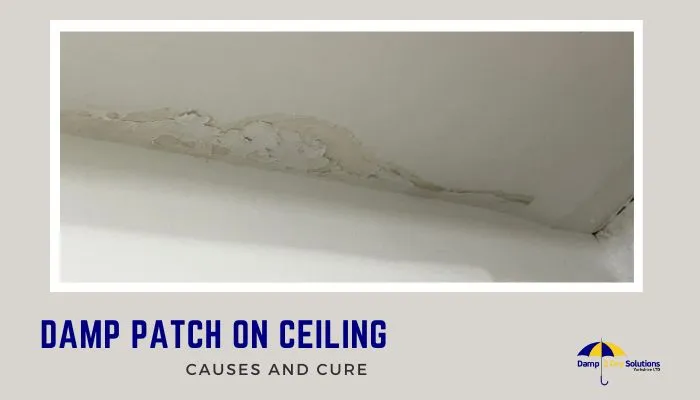
Two ceilings with identical stains can be separated by a factor of ten, and none of that spread is negotiating margin. It is construction, duration, what sits above the plaster, and whether anyone measured before closing it up.
Why there is no single price for a water damaged ceiling
A stain on a ceiling describes the symptom, not the job. The work behind it might be two hours with a stain block and a roller, or it might be a ceiling taken down, joists dried over several weeks, a lighting circuit tested, insulation replaced and a new plasterboard ceiling skimmed and decorated. Those are not the same trade, the same duration or the same order of cost, and no useful figure spans both.
That is why a quote given over the phone from a photograph is close to meaningless, and why quotes for the same ceiling can differ several times over. They are not pricing the same scope. One has assumed a patch; another has assumed the ceiling comes down. Until someone has been up above it and taken readings, nobody knows which is correct.
What follows is what actually moves the number, in the order it usually moves it. If you are comparing quotes, these are the questions to put to each one, because a quote that does not address them is a guess with a total attached.
What the published averages actually measure
There are published figures for ceiling repair, and they are worth reading carefully rather than quoting loosely. Checkatrade's ceiling repair cost guide has carried an average of £162, a typical range of £115 to £234, an overall spread of £80 to £1,600, and an hourly rate of £95 to £145. Those are Checkatrade's figures rather than ours, published cost guides are revised periodically, and the spread is the informative part. The same guide places the top of its range where a leak has caused water damage and both an electrician and a plasterer are needed, which is precisely the distinction this article is about.
| Checkatrade figure | What it most likely describes | What it is unlikely to include |
|---|---|---|
| £162 average | A small, dry repair or patch in an accessible room | Drying, structural work, electrical testing |
| £115 to £234 typical range | Routine patching and making good | Full ceiling replacement |
| Up to £1,600 at the top of the spread | A ceiling taken down and replaced | Specialist drying, asbestos work, scaffold access |
| £95 to £145 per hour | Trade labour rate | Materials, waste, access equipment |
The deeper problem with averages here is that they average across a distribution with two humps. Most ceiling repairs are small and dry. A minority involve water, and those cluster at a different order entirely because the plaster is the last item on the list rather than the first.
The ceiling itself: lath and plaster, or plasterboard
This is usually the largest single driver, and it is decided by the age of the building rather than by the leak.
Lath and plaster
In London that means most ceilings in properties built before roughly the 1930s, and many later ones that were never replaced. Timber laths are nailed across the joists and lime plaster is pushed through the gaps to form nibs that hook over the back of the laths. That mechanical key is what holds the ceiling up, and water destroys it. The plaster swells, the nibs soften and shear, and the ceiling separates from the laths while still looking intact from below.
A lath and plaster ceiling that has been wet therefore cannot be assessed from the finish. It is assessed by pushing up gently from below and by looking at the back of it from above, and the question is whether the key survives. Where it has gone, patching is not an option, because the surrounding plaster has nothing holding it. Where a ceiling carries original cornice or a ceiling rose, replacement moves from a plastering job to a specialist one, and in a listed building or a conservation area consent issues may attach as well.
Plasterboard
Standard gypsum board behaves differently. It absorbs water, sags under the weight, and loses strength permanently in the saturated area, but the failure stays local and the board is fixed mechanically to the joists rather than keyed. A saturated board is cut out to the nearest joist centres either side, a new piece is fitted, and the joint is taped and skimmed. Moisture resistant board, common in bathrooms, resists surface wetting but is not waterproof and still fails when soaked from above.
| Construction | How it fails when wet | What repair usually means |
|---|---|---|
| Lath and plaster | Plaster nibs soften and shear, ceiling separates from the laths | Often full removal of the affected bay or the whole ceiling |
| Lath and plaster with cornice or rose | As above, plus loss of running mouldings | Specialist fibrous plaster work, mould taking and running in situ |
| Plasterboard, skimmed | Board sags and loses strength locally | Cut out to joist centres, new board, tape and skim |
| Plasterboard with a textured coating | As above, plus the coating cannot be matched | Whole ceiling, because a patch will always read |
| Suspended or MF grid ceiling | Tiles or boards deform, grid may corrode | Tile replacement, or grid section renewal |
Patch, or ceiling down
This single decision separates the two humps in the distribution, and it is not a judgement call so much as a consequence of four facts.
- Did the water reach the key or the fixings? On lath and plaster, a lost key means the ceiling comes down. On plasterboard, sagging between fixings means the board is finished.
- Is the void accessible another way? If the floor above can be lifted, the leak can be reached and the void inspected and dried without opening the ceiling. If it cannot, the ceiling is the access route and it comes down anyway.
- Can the finish be matched? A flat white ceiling patches invisibly. A textured coating, a heavily stippled finish or an old ceiling with a century of settlement in it does not, and a patch that reads across a room is not a completed repair.
- Is the area near the perimeter or in the middle? A patch in the middle of a large span is more visible and more difficult to support than one against a wall.
Where the ceiling does come down, several costs arrive at once that a patch never incurs: protection and clearance of the room below, waste removal, the void becoming visible and revealing its own problems, and full redecoration rather than a touch in. The plastering is rarely the expensive part of a ceiling replacement.
What sits above the plaster
Opening a ceiling generally reveals three things, and each has its own cost line.
Insulation and joists
Saturated mineral wool insulation compacts, loses most of its thermal performance and holds water against timber for weeks. It does not reliably recover, and in a loft or intermediate floor void the usual answer is removal and replacement rather than drying in place. Joists are more forgiving: seasoned softwood tolerates a single wetting well, provided it dries. What it does not tolerate is being closed back up damp, because sustained elevated moisture in unventilated timber is where wet rot and, in the wrong conditions, dry rot begin. Structural timber that has been wet needs readings, not a visual inspection.
Electrics
Ceiling voids carry lighting circuits, and often power circuits, junction boxes and downlight transformers. Water in a junction box or a downlight housing is not something that dries out and is forgotten. Any circuit that has been wet should be isolated, inspected and tested to BS 7671, the wiring regulations, before it is re-energised, and damaged accessories replaced. This is a frequent omission in fast quotes, and it is also the item most likely to produce a serious incident if it is skipped. Recessed downlights are a particular problem, because they are the route by which water reaches the circuit and because they also breach the ceiling's fire resistance where fire rated fittings have not been used.
The related subject of what to do at the moment water appears around a light fitting is covered in water leaks and electrical safety.
How long the leak ran
Duration changes the job more than volume does. A sudden burst that dumps a large quantity of clean water into a void and is stopped within the hour is, structurally, a better outcome than a weeping joint that has released a small volume every day for two years.
| Leak history | Typical condition of the void | What it adds to the scope |
|---|---|---|
| Sudden failure, stopped quickly | Heavily wet, uniformly, over a defined area | Drying, localised plaster repair |
| Weeks of slow seepage | Damp timber, compacted insulation, early mould growth | Insulation replacement, mould treatment, longer drying |
| Months or years | Rot risk in joists and ends, salt staining, corroded fixings | Timber repair or replacement, possible structural input |
| Repeated wetting and drying | Cyclical movement, cracked plaster beyond the wet area | Wider repair than the stain suggests |
| Contaminated water, for example from a waste pipe | Bacterial contamination as well as saturation | Cleaning and disinfection, more material discarded |
Duration also decides the insurance position, because buildings policies respond to sudden escapes of water and generally not to gradual deterioration. Establishing how long a leak has been running is a technical question with a financial answer, and it is dealt with separately in how to tell if a water leak is new or old.
Drying to measured readings, not to appearance
A ceiling that looks dry is not a ceiling that is dry. Plaster surfaces give up moisture quickly while the timber and the masonry behind them hold it, and the difference between a surface reading and a depth reading on the same element is routinely large.
Structured drying means recording target readings for each affected material, monitoring at fixed intervals with the same instruments in the same positions, logging the results, and reinstating only when the readings are met. BS 12999:2015, the British Standard code of practice for damage management, sets out how that process is organised, from on site assessment and stabilisation through damage scoping to completion and sign off. A drying log is the document that shows the readings were met. Its absence is the reason a second claim on the same ceiling is hard to defend.
Where drying goes wrong
Drying is the stage most often curtailed, and it fails in predictable ways.
- Surface readings mistaken for the condition of the element. A pin meter on plaster reads the plaster. It says nothing about a joist behind it.
- Dehumidifiers running with the windows open. A refrigerant dehumidifier conditions the air in a closed space. Ventilating the room at the same time wastes the whole operation.
- Heat without extraction. Warming a room raises evaporation and raises the humidity of the air, and without a means of removing that moisture it simply redeposits it somewhere cooler, often inside a wall.
- Reinstating over trapped moisture. Closing a void with damp insulation and damp timber inside it produces mould, odour and eventually rot, and the second repair costs more than the first.
- No baseline reading. Without a reading from an unaffected part of the same building, there is nothing to dry back to.
- Drying before the leak is fixed. Obvious, and it still happens, usually when the source was assumed rather than located.
Where a ceiling is wet and the source has not been established, drying is premature. The sequence is to establish where the water is coming from first, because everything downstream of that is otherwise being done twice.
Asbestos, access, and the costs people forget
Three further items sit outside the plastering scope and are capable of dominating it.
Textured coatings in pre-2000 buildings
Textured coatings applied to ceilings before 2000 may contain chrysotile asbestos. Undisturbed, they present no risk. Sanding, scraping, drilling or breaking them out is disturbance, and work liable to disturb asbestos containing materials is regulated under the Control of Asbestos Regulations 2012. In practice that means the coating is sampled and analysed before any work that would break it, and if it is positive the removal is handled accordingly. This is a scheduling issue as well as a cost one, because the sample result gates the start of work.
Access, height and occupation
A ceiling in a ground floor room of an empty house is a straightforward working environment. The same ceiling in a stairwell, in a double height space, in an occupied flat that has to be worked around, or in a block where the work has to be done outside certain hours carries access costs that have nothing to do with the damage. Communal areas add protection of the route, permits and sometimes out of hours working. In a listed building, matching materials and consent requirements can change the approach entirely.
The costs that follow the ceiling
Redecoration rarely stops at the repaired area, because a patch of fresh paint on an older ceiling reads as clearly as a stain. Carpets and flooring below may need lifting and drying. Contents need moving and sometimes storing. Where a flat is uninhabitable during drying, alternative accommodation becomes a line in the claim. None of these is plastering, and all of them arrive with the ceiling. The insurance claims page covers how these are separated out so each lands against the right section of the policy.
The practical conclusion is simple enough. Get the source located and stopped, get the void opened enough to see what is actually in it, get readings taken and logged, and only then ask anyone for a price. A number produced in that order is a quote. A number produced before it is a hope.
How we help with this
If the article describes a problem you actually have, these are the visits that deal with it.
- how our pricing works
What sets the fee for a survey, and what is confirmed before we travel.
- damp and moisture surveys
Moisture mapping that separates a leak from condensation or damp.
- our full guide to leak detection
How each method works and when it is the wrong tool for the job.
Frequently asked questions
Is there an average cost for repairing a water damaged ceiling?
Published averages exist but they mostly describe dry repairs. Checkatrade's ceiling repair cost guide has carried an average of 162 pounds, a typical range of 115 to 234 pounds, an overall spread of 80 to 1,600 pounds and an hourly rate of 95 to 145 pounds. Those are Checkatrade's figures and published guides are revised periodically. Water damage sits at the upper end because the plaster is the last item rather than the first, behind drying, insulation, timber and electrical work.
Why do quotes for the same ceiling differ so much?
Because they are not pricing the same scope. One assumes a patch and one assumes the ceiling comes down, and until someone has been into the void and taken readings nobody knows which is right. The difference usually turns on whether the ceiling is lath and plaster or plasterboard, whether the plaster key or the board fixings have failed, whether the finish can be matched, and what condition the insulation, joists and lighting circuit are in.
Does a lath and plaster ceiling always have to come down after a leak?
Not always, but far more often than plasterboard. Lath and plaster is held up by nibs of plaster squeezed through the laths, and water softens and shears that key while the ceiling still looks intact from below. Where the key has gone, patching is impossible because the surrounding plaster has nothing holding it. The assessment is made by pressing up gently from below and inspecting the back of the ceiling from above, not from the painted finish.
Can the ceiling just be dried out and painted over?
Only if measured readings say it is dry, and a surface reading on plaster does not say that. Structured drying means setting target readings for each affected material, monitoring at fixed intervals with the same instruments in the same positions, logging the results and reinstating only when the targets are met. BS 12999:2015, the code of practice for damage management, covers how that is organised. Closing a void over damp timber and compacted insulation produces mould, odour and eventually rot.
Do the electrics need checking if water came through a light fitting?
Yes. Ceiling voids carry lighting circuits, junction boxes and downlight housings, and water in any of those does not simply dry out and become safe. Any circuit that has been wet should be isolated, inspected and tested to BS 7671, the wiring regulations, before it is re-energised, and damaged accessories replaced. Recessed downlights deserve particular attention, because they are usually the route by which water reaches the circuit in the first place.
Could there be asbestos in a textured ceiling?
Textured coatings applied before 2000 may contain chrysotile asbestos. Left undisturbed they present no risk, but sanding, scraping, drilling or breaking them out is disturbance, and that work is regulated under the Control of Asbestos Regulations 2012. In practice the coating is sampled and analysed before any work that would break the surface. This affects the programme as well as the cost, because the analysis result determines when and how the repair can start.